Showing posts with label fire pit. Show all posts

Thursday, 11 October 2018

The Dakota Fire Hole

By Survivalman


Unless you are a survivalist, you are probably not aware of the Dakota Fire Hole, and even some of you who are adventurers may not know about this gem. Sometimes referred to as the Dakota Fire Pit, this way of building a fire is superior over all others. In fact, most people who try one for the first time, never go back to other fire building methods.
The Dakota Fire Hole uses less firewood and fuel to keep it going, even though it may take longer to build and require more effort. It is well worth it in the end when you realize how efficiently it works. The fire is hotter, it requires less maintenance, and is safer than other fires. It is also easier to cook with and has limited smoke. When you want to stay hidden this is a big plus, in addition to the pit concealing the fire flame.
Location
The location in which your build your fire is important. You want soil that is sturdy but soft enough to dig into.
  • Do Not try to build in …
Rocky dirt
-Wet dirt
-Water filling up hole
-Dirt with thick tree roots
-Dry and loose soil
Building Your Dakota Fire Hole
  • The Materials:
Shovel or stick to dig with
  • The Hole:
Dig a circular hole, in grassy dirt, that is about 10 to 12 inches around.
-Dig about on foot deep, and pull the grass plug out to save for later
-At a foot deep, dig a few inches wide going in all directions. This will make room for longer fire wood.
-Now you have 12 foot wide hole that goes down a foot and then gets wider to      about 15 inches around.
-The neck is the chimney, and the wider part is for the firewood.
  • The Airway
 –This is one of the most important parts of the Dakota Fire Hole and what makes it so efficient.
-Determine wind direction by licking a finger and holding it up to the wind. The      side that dries fastest is the side the wind is coming from
-The airway will be built on the side from which the wind is blowing.
-At about a foot from your chimney hole, dig a 6 inch wide circular hole. Dig down             more than a foot, angling toward the base of your Dakota Hole, and intersect it by             digging into it. You should not be able to place your hand in the airway hold and   see it appear at the base of your Dakota Hole.
-Add kindling wood to the base of your Dakota Hole, filling it partially.
-Start the fire, preferably with a FireSteel. It will be harder with another kind of       lighter.
Unless you are a survivalist, you are probably not aware of the Dakota Fire Hole, and even some of you who are adventurers may not know about this gem. Sometimes referred to as the Dakota Fire Pit, this way of building a fire is superior over all others. In fact, most people who try one for the first time, never go back to other fire building methods. The Dakota Fire Hole uses less firewood and fuel to keep it going, even though it may take longer to build and require more effort. It is well worth it in the end when you realize how efficiently it works. The fire is hotter, it requires less maintenance, and is safer than other fires. It is also easier to cook with and has limited smoke. When you want to stay hidden this is a big plus, in addition to the pit concealing the fire flame. Location The location in which your build your fire is important. You want soil that is sturdy but soft enough to dig into. • Do Not try to build in ... -Rocky dirt -Wet dirt -Water filling up hole -Dirt with thick tree roots -Dry and loose soil Building Your Dakota Fire Hole • The Materials: -Shovel or stick to dig with • The Hole: -Dig a circular hole, in grassy dirt, that is about 10 to 12 inches around. -Dig about on foot deep, and pull the grass plug out to save for later -At a foot deep, dig a few inches wide going in all directions. This will make room for longer fire wood. -Now you have 12 foot wide hole that goes down a foot and then gets wider to about 15 inches around. -The neck is the chimney, and the wider part is for the firewood. • The Airway -This is one of the most important parts of the Dakota Fire Hole and what makes it so efficient. -Determine wind direction by licking a finger and holding it up to the wind. The side that dries fastest is the side the wind is coming from -The airway will be built on the side from which the wind is blowing. -At about a foot from your chimney hole, dig a 6 inch wide circular hole. Dig down more than a foot, angling toward the base of your Dakota Hole, and intersect it by digging into it. You should not be able to place your hand in the airway hold and see it appear at the base of your Dakota Hole. -Add kindling wood to the base of your Dakota Hole, filling it partially. -Start the fire, preferably with a FireSteel. It will be harder with another kind of lighter. How It Works • Hot air rises up the chimney creating a suction that pulls air into the airway tunnel, feeding the fire. Since it’s build on the windward side of the Dakota Hole, there will be sufficient wind. • With oxygen continually feeding the fire, it burns at a hotter temperature and more effectively than fires that sit on top of the ground. • You will use less wood to keep it going and the heat is funneled upward towards you. Cooking You can easily cook on the Dakota Fire Hole by placing a flat rock partially over the hole to use as a cooking surface. If you have camp gear for cooking, you can place a grill over the hole, or use pans on the hot rock. Cleanup This is where the dirt plug comes into play. Shovel dirt into the hold to cover the fire, which will smother it and put it out. Then place the dirt cap on top. Summary: A Dakota Fire Hole is great for camping or for survival in the wilderness. When using for camping, you can use your own cooking gear. If you are in a dire situation where you are hiding out and do not want other people to find you, this fire creates the least amount of smoke and the flame is hidden from view at night. When you clean up, there is no trace that you were ever there. The dirt cap hides everything, and you can re-use the hole at a later time. A fire is essential to any camper or survivalist. It provides warmth and cooking ability. It is important to know how to build a safe fire, and also to learn how to keep it going. You don’t want to be expending all your energy feeding your fire which is why the Dakota Fire Hole is one of the best choices in fire making. Once it is built it is pretty self sufficient, with the airway feeding the flames which burn hotter and longer than a conventional fire. Always be safe and never build a fire near wild fire risk locations.
How It Works
  • Hot air rises up the chimney creating a suction that pulls air into the airway tunnel, feeding the fire. Since it’s build on the windward side of the Dakota Hole, there will be sufficient wind.
  • With oxygen continually feeding the fire, it burns at a hotter temperature and more effectively than fires that sit on top of the ground.
  • You will use less wood to keep it going and the heat is funneled upward towards you.
Cooking
You can easily cook on the Dakota Fire Hole by placing a flat rock partially over the hole to use as a cooking surface. If you have camp gear for cooking, you can place a grill over the hole, or use pans on the hot rock.
Cleanup
This is where the dirt plug comes into play. Shovel dirt into the hold to cover the fire, which will smother it and put it out. Then place the dirt cap on top.
Summary:
A Dakota Fire Hole is great for camping or for survival in the wilderness. When using for camping, you can use your own cooking gear. If you are in a dire situation where you are hiding out and do not want other people to find you, this fire creates the least amount of smoke and the flame is hidden from view at night. When you clean up, there is no trace that you were ever there. The dirt cap hides everything, and you can re-use the hole at a later time.
A fire is essential to any camper or survivalist. It provides warmth and cooking ability. It is important to know how to build a safe fire, and also to learn how to keep it going. You don’t want to be expending all your energy feeding your fire which is why the Dakota Fire Hole is one of the best choices in fire making. Once it is built it is pretty self sufficient, with the airway feeding the flames which burn hotter and longer than a conventional fire. Always be safe and never build a fire near wild fire risk locations.

Monday, 30 July 2018

How To Build An Upside Down Fire

How To Build An Upside Down Fire

upside down fire
This past weekend The Bug Out Bag Guide Family hosted a barbecue for some close friends.  One of the highlights of this was testing out an alternative fire building method in our back patio firepit.  Instead of building a standard teepee or log cabin we decided to try building what is called an “upside down fire”.  We got some great, hassle-free results from this that we wanted to share with you.  As I always say, it is always good to add new techniques to your survival skills.  At the end of this article you will know how to build an upside down fire on your own!

Why build an upside down fire?

Over many years of camping I have built hundreds of fires.  These were mostly of the teepee and log cabin variety, with some lean-to fires mixed in as the situation required.  These fire building methods have served me well and I have enjoyed many a meal and evening sitting around their warm glow.
I was excited to learn about a new method of fire building and try it out for myself.  What I learned from my test run, is that there are several advantages that an upside down fire brings to the table.
Upside Down Fire
Here is one I built at home

An upside down fire is self feeding

An upside down fire is built in a layered fashion starting with tinder at the top and increasing in size all the way to large logs at its base.  One of the biggest advantages of using this fire building method is that as a layer burns it progressively ignites the larger layer below it.  The tinder lights the kindling, which ignites the fuel wood, which in turn lights the logs.  In other words, once an upside down fire is lit it will burn by itself for hours.  There is no need to baby sit it and keep adding wood over time!  You can light your upside down fire and then focus on other tasks like setting up camp, preparing food, or just relaxing with your fellow campers.
While traditional fires (teepee and log cabin) do progressively ignite successive layers (if properly built!) they tend to do this over a shorter period of time and require that a fire tender monitors the burn rate and add more fuel and eventually place logs onto the fire.  The genius of an upside down fire is that it frees you from this chore!
Being self feeding makes an upside down fire an excellent choice if you want to keep a heat source burning through a long, cold night.  As it is self feeding you will be able to build it before bed, light it, and then keep warm without having to climb out of your sleeping bag or shelter.
Upside Down Fire
Here is that same fire after 10 minutes

An upsidedown fire generates lots of coals

As an upside down fire burns it creates a large supply of coals from the logs integrated into the base of the design.  These logs are lit as the flame consumes the fuel wood and transfers heat down to this base layer.  These coals are excellent for most cooking purposes.  With a good bed of coal you can:
  • cook foil packets
  • heat up a dutch oven
  • barbecue meat, fish, or vegetables
  • and much, much more…
With a traditional fire you would need to set up your teepee or log cabin and as they got burning need to continually feed it larger and larger logs to get a nice bed of coals going.  The upside down fire does this automatically with the same amount of wood but far less active management.  Set it up, go get your food ready and then come back to a nice bed of cooking coals!
Upside Down Fire
…And again after 40 minutes

Where can I use an upside down fire?

An upside down fire can be used pretty much anywhere you would build a traditional fire.  It can be a great option for many applications:
  • Survival cooking
  • Camping
  • Bonfire
  • Barbecue
  • Wood Stove
  • In home fireplace
  • Rubbish disposal

Can I build an upside down fire in a fireplace?

Yes!  People often build them in fireplaces or woodstoves for the same reasons why they are used outdoors.  Wood stove enthusiasts actually favor the upside down fire building method as it tends to heat up the chimney pipe faster than a traditional fire and by doing so increases the stove’s efficiency.
Upside Down Fire
…And finally, the same fire after an hour burning without my intervention!

How to make an upside down fire

Here is a step by step guide for building your own upside down fire.  Follow the written instructions and refer to the pictures if you run into any trouble.

Step 1: Clear your fire pit

You are going to lay your base layer of logs down in the next step so you will want your pit clear of debris and as level as possible so the fire you build will not topple over as you build it up.
How to build an upside down fire
Clear your fire pit out

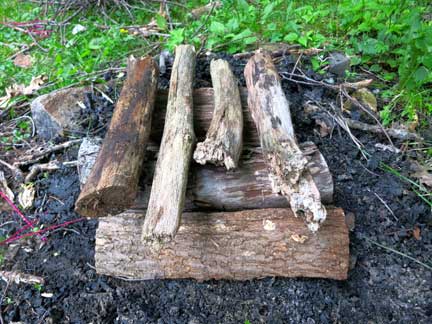
Step 2: Lay down the base logs

You are going to build your base layer first.  This means use the largest logs you intend to burn and lay them down parallel to each other.  Have the logs all touching each other so there are no gaps between them and it is best if the tops of them are relatively level with each other so you will have a nice sturdy base to build the rest of your fire upon.
How to build an upside down fire
Lay down your base logs

Step 3: Thicker Fuel Layer

You are going to use large fuel wood for this layer, larger than your thumb.  Remember, this layer has to be large enough to generate enough coals and heat to ignite the logs below it.  Lay this wood in the opposite direction to the logs below it and allow space between each piece for air to flow.  Feel free to build 1-3 layers of this sized wood if you have enough and if you have organized your wood build each layer upwards out of slightly smaller thickness pieces.  Each layer should be laid down crosswise (perpendicular) on top of the layer below, similar to the method used when building a log cabin.
How to build an upside down fire
Add on your fuel wood

Step 4: Smaller Fuel Layer

You are going to repeat the process used in step 3 here but using smaller fuel wood, preferably smaller than your thumb in thickness.  Once again build 1-3 layers of small fuel wood up with each being perpendicular to the last layer and slightly smaller thickness.  You should have a small tower of wood now with the thickness of pieces used getting gradually smaller as you get nearer to the top.
How to build an upside down fire
And now your smaller fuel wood

Step 5: Kindling

Now you are going to start adding on the smaller wood that you have, kindling that is thinner than your pinky.  Add 3-5 layers of this if you have enough to do so.  By the time you get to the top layer the wood should be of the smallest thickness you have, no bigger than a twig.  Stick to the same method of laying each layer down crosswise across the layer below it to allow proper air flow.
How to build an upside down fire
Get your kindling on there next
How to build an upside down fire
And the small twigs on top

Step 6: Tinder

Choosing and adding your tinder is a crucial last step.  You need something that is small enough to be ignited with your match, lighter, or firestarter but that will burn long and hot enough to get your kindling to start burning.  Place this tinder on top of your kindling.  Here are some suggestions for kindling that have worked well for me in the past:
How to build an upside down fire
Finally place your tinder at the very top

Step 7: Light And Enjoy!

Shelter your match and tinder from any wind (If you are lighting your fire with an EverStryke Match, you don’t need to worry about this) and get that fire started.  Depending on what tinder you chose you may need to blow gently to get the tinder going.  As the fire burns each layer that you built should ignite the next one down all the way to your base layer of logs.  In my testing an upside down fire built as I have described should burn for well over an hour and result in a large layer of coals all ready to cook your meal.  Enjoy!
How to build an upside down fire
Your upside down fire is ready to light and enjoy!

Your Turn!

So, now you know how you build your own upside down fire.  I encourage you to give it a try next time you are camping or setting up a backyard bonfire.  It is a great tool to add to any fire building arsenal and I think you will be impressed with the results.

Wild Camping Tips and Kit List

The first rule of Wild Camping club is...  actually really simple! Leave No Trace: if you take it in, you carry it out. What is wild camp...