Showing posts with label sleeping bag. Show all posts

Friday, 16 March 2018

UK WILD CAMPING: YOUR ESSENTIAL KIT LIST AND CAMPING RULEBOOK

Sometimes there’s nothing more freeing than pitching your tent away from the hustle and bustle of everyday life and exploring the untouched, remote corners of the UK. As wild camping grows in popularity, here is the essential kit list and rulebook including the laws and golden rules you need for camping on undesignated wild land in Britain. 

What is WIld Camping?

Wild camping means pitching your tent or sleeping in your bivvy bag outside of an official or authorised campsite. 

Unlike designated campsites, wild camping gives you the chance to spend the night in undiscovered and remote locations, rewarded with stunning scenery, tranquillity, and a sense of independence in the outdoors.

As Alastair Humphreys highlights, your wild camp doesn’t need to be in the most remote corner of the Scottish Highlands. It can simply be in your local woods or on countryside tops just outside of the city.

Camping in the wild is widely welcome in Scotland but discouraged and technically illegal in most areas of England and Wales, but wild campers are largely tolerated as long as you respect the hills and locals.

What Gear do I Need to Pack?

You want to keep wild camping as ultralight as possible, however you shouldn’t skimp on the essentials if you want a truly comfortable and enjoyable experience.

SLEEPING

Always go for the basics when wild sleeping: 
  • An ultralight tent such as the MSR Hubba NX, or a bivvy bag, a minimalist, waterproof and breathable shelter
  • Sleeping bag
  • Sleeping mattress
  • Head torch and don’t forget to pack spare batteries just in case! 

PACK

Choose a comfortable backpack with a waterproof cover and enough storage for your essential kit list.  
For multi-day treks with more than one wild camp, ensure that there’s enough space for food supplies.

COOKING

You won’t need a whole kitchen for a few days away but the following cooking essentials always come in handy:  
  • Compact and reliable cooking stove with pot
  • Fork, knife, and spoon
  • Bowl and mug
  • Matches and lighter
  • Water bottle or hydration bladder
  • Purification tablets or water filter (water collected from natural flowing sources like rivers and streams must always be purified)
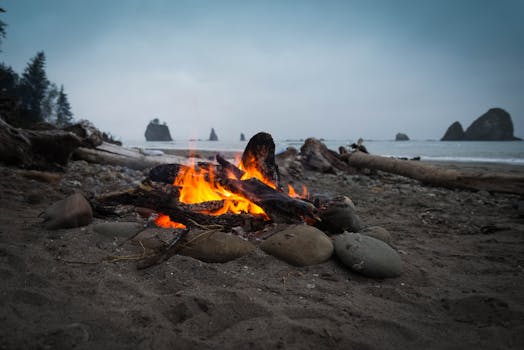
Free stock photo of sea, beach, sand, water

FOOTWEAR

Durable walking boots with sufficient ankle support are necessary for navigating through remote areas with more challenging terrain. 

CLOTHING

Prepare for walking in the changeable and unpredictable weather with technical outdoor clothing: 
  • Waterproof jacket
  • Waterproof trousers
  • Fleece or mid layer for warmth
  • Technical base layer to wick away sweat
  • Technical walking socks to minimise blisters
  • Wooly hat for in-camp warmth

What are the Laws in the UK?

Although you should always ask for permission whenever possible while wild camping, it can be tricky if you don’t know who owns the land and there is no consistent policy for wild camps across the UK either.  

SCOTLAND WELCOMES WILD CAMPERS

The Scottish Outdoor Access Code means that you can camp almost anywhere you please in Scotland. 
An exception to the rule is the East Loch Lomond Restriction Zone, which doesn’t permit wild camping from 1 March-31 October to help ease human impact on the area. 

ENGLAND + WALES CAN BE TRICKIER

Dartmoor is the only National Park in England which provides designated spots for legal wild camping while the Brecon Beacons National Park also has two of its own official wild camping areas, Melte and Llech Llia. 
The Lake District, Snowdonia, and Exmoor National Park all welcome remote, one-night stops, however the Peak District, North York Moors, and Yorkshire Dales discourage unpermitted camping or bivvying. 

So What are the Golden Rules of Wild Camping?

Although the laws differ between Scotland, England and Wales and our National Parks, there are some universal rules to follow wherever you wild camp. 

CAMP WITH CONSIDERATION

  • Camp using small tents which blend into the landscape
  • Keep your group as small as possible
  • Camp on flat, dry land and never on top of crops or fauna
  • Never disturb rocks, vegetation, or wildlife to make your pitch
  • Camp at least 100m away from trails, roads, and residential areas
  • Camp high where you’re out of sight from houses and buildings
  • Pitch your tent late and leave early the next morning
  • Don’t stay for more than one night (unless the National Park says otherwise)

LEAVE WITHOUT TRACE

  • Never start campfires and ensure that you protect the ground when using your cooking stove
  • Search your site after you pack up your equipment to make sure that you haven’t left any litter
On leaving without a trace, long-distance walker and wild camper Chris Townsend recommends you “always leave an area as pristine as possible so that no-one passing by will know it’s been used. If anyone ever camps there again, they too can have the joy of a real wild site and that feeling of being in untouched nature.” 

Wednesday, 7 February 2018

Wild Camping Part Two - Shelter


Andy Torbet

Extreme adventurer and explorer, presenter and zoologist

What you'll need to wild camp will depend on the weather and how close you want to get to nature. It also depends on how long you're out for. But let's assume it's a single overnighter and you can extrapolate from there.
Your basic needs when you stop for the night is food to recover from all the adventurous activities and to fuel up for more tomorrow. You'll also need some degree of shelter from the elements in order to recover and get a good night's sleep. I'll deal with food and cooking next week but for now let's look at shelter.
The greater the degree of shelter and comfort the greater the weight I'm afraid. Less of a problem when you're using something like a canoe or kayak but if you're trekking into your campsite or parachuting in and weight is an issue then you do not want to be carrying the equivalent of a fruit machine on your back. So at the top end is a tent.
Free stock photo of landscape, nature, vacation, water
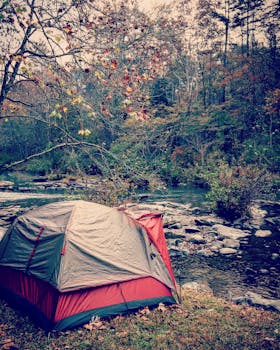
A tent will keep the wind off, the rain off and give a degree of extra warmth and privacy. It's the best option as far as pure shelter is concerned, however, it has disadvantages too. Foremost is its weight. The weight can be shared between your compatriots depending on how big the tent is but it's still relatively heavy, although some very lightweight versions are now available. However, the lighter the tent the weaker it is, usually, which means something that will cope with a high altitude mountain storm will weigh more than something you use on a beach on a summer's night. Tents take time to put up which can be a pain when it's wet, windy, you're tired and just want to go to bed. But the biggest drawback for me is that it removes you from the environment. There is also bulk and I prefer to keep things small and compact, especially if I'm climbing or moving through restrictive terrain (e.g. dense forest or jungle). Although sometimes a tent is essential. If it's minus 30 outside, an eighty mile an hour wind is blowing and it's snowing (which I've experienced) you'll be very grateful for your tent. But normally I like to be out under the stars. So the other option is a bivi.
This consists of a sleeping bag and a bivi bag, which is effectively a waterproof shell for your sleeping bag. This way you can literally sleep under the stars. If it's likely to rain I often take a basha (an Army term) which is just a small tarpaulin that you can set up over you to get the worst of the rain and wind off you. You simply run a line between two trees, lay the tarpaulin over it and secure it to the ground at the corners - so it looks like the roof of a house. The worse the weather the closer you should secure it to the ground to keep drafts out. If there are no trees where you're going you can take two lightweight extendable poles or use your walking poles.
The final thing to cover is the sleeping mat. The more comfortable they are the heavier they are but that extra thickness also insulated you from the ground, making you considerably warmer, allows you to sleep on rockier ground and will allow for a better night's sleep. People are divided on this and it may depend on how long you are out for whether you can cope with less quality to your sleep but I'm a fan of sleeping well when I'm out. A little extra weight is worth the chance to recover properly during the night. The foam, inflatable mats are good. They are comfortable and warmer for their weight but expensive and can be punctured so require more looking after. The simple foam mats are very cheap and won't puncture but are less comfortable, warm and are bulky. My final top tip is, if you're bivi-ing, stick your mat inside your bivi bag. It'll keep it dry and stop you sliding off it. However, a word of caution, if the ground has sharps on it (sharp stones, sticks or bits of wire, rubbish, etc ( I've had to camp on a beach with broken glass over it once while sea kayaking)) put the mat (ideally a non-inflaltable one) on the bottom - they are much cheaper to replace than a bivi bag.
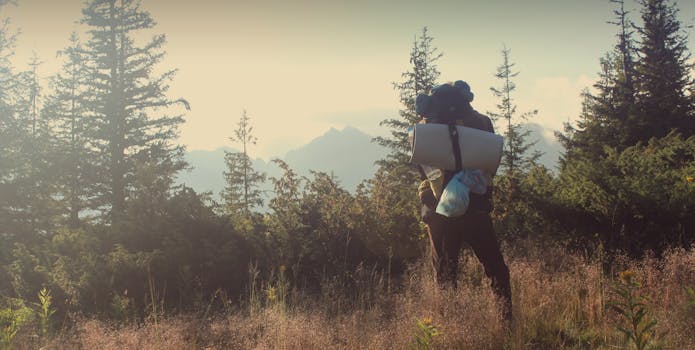
Free stock photo of nature, outside, hiker, hiking
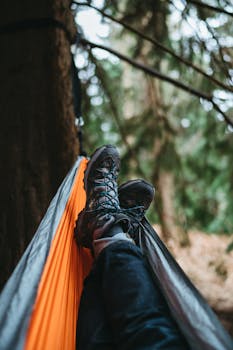
You can also consider a hammock. These aren't just for the jungle, I've used them in Scotland. You can string it between two trees, still rig your basha over the top if it's raining (although you need some extra string to tie to the corners and extend it to your ground anchors) and you won't need a mat to sleep on, thereby saving weight as a hammock weighs much less than a mat. However, the lack of mat can reduce the insulation on your back as you're lying, and crushing, your sleeping bag. I'll often pack the hammock with my clothes to overcome this: wet clothes on the outside of the bivi bag, dry ones on the inside. Obviously if there are no trees of rocks to hang a hammock it's not a great option.
Person Wearing Pair of Black Hiking Shoes Lying on Orange and Gray Hammock
And finally consider your site. Try and get out of the wind, find an area where the ground is not wet or likely to become wet (I knew someone who camped in a ditch. Dry and sheltered from the wind but when it rained during the night it became a stream...). Look for a patch of flat and even ground, sloping ground will have you waking up all night, and clear away any rocks, sticks or debris. A little time in site selection and preparation will pay dividends when you climb into bed.
Oh and one very last point - dry bags. If you only buy one then buy one big enough for your sleeping bag...in fact buy two and double bag it. If every other bit of kit gets a soaking then one piece that must stray dry is your sleeping bag. Trust me.
Next week I'll deal with food and cooking.

Wild Camping Tips and Kit List

The first rule of Wild Camping club is...  actually really simple! Leave No Trace: if you take it in, you carry it out. What is wild camp...