Showing posts with label tent pitching. Show all posts

Wednesday, 18 April 2018

A BEGINNER'S GUIDE TO WILD CAMPING

Wild Camping | beginners

Spending a night under the stars away for civilisation is a feeling money can’t buy, it allows you a sense of freedom for the body and mind, as well as a sense of achievement, it’s the ultimate GetOutside adventure.
Wild camping is something everyone should try to sample at least once, and remember we’re discussing Wild Camping the Mud and Routes way, not the ‘other’ kind in laybys and the like!

WHAT SKILLS DO I NEED?

bochlwyd_wildcamp-1-of-2.jpg
If you’re a seasoned hill walker, then you’ve got the trickiest part sorted. The hardest part of most mountain trips is the navigation, and if you’re wild camping properly then you’ll need to go places where some map reading skills are essential. Beyond that, you’ll need to choose your kit wisely and learn how to use it.
It should go without saying that you need to be able to pitch your tent in any conditions that you expect to encounter, even if that means you’re pitching in the garden with the sprinkler on full pelt.
You should also make sure that kit’s suitable for the type of conditions you’re going to be camping out in. You can either cook already, or you can’t. If you can, then wild camping is an opportunity to be creative. For everyone else, there’s always dehydrated food.
Beyond that, you just need to be able to sleep in a tent. Our own Dave Roberts loves wild camping, but admits that he sleeps awfully in a tent without a few single malts to set him nicely off. We don’t believe a word of it!

WHAT EQUIPMENT DO I NEED?

To start with, you’ll need everything that you generally take on a day walk, plus a few choice spares. The main kit you’ll need are the ‘Big 3 items; tent, sleeping bag and rucksack.
These are the heaviest and often your biggest investment financially, so it’s well worth taking some time and googling any item that takes your fancy. The guide that follows gives you a quick overview of what to look for: Your First Wild Camp.
Don’t automatically think that this is the money no object outdoor adventurer activity though, as we’ve proven before at Mud and Routes you can achieve wild camping on a budget.
“But what about my luxuries?” we hear you say. Fear not, there’s no reason why you can’t make wild camping that bit more comfortable too if you go in for that sort of thing. Roasted coffee, tables and chairs, even popcorn and projected movies!
We’ve become so proficient at it here at Mud and Routes that we’ve coined a category for it, Wild Glamping! Check out our adventures for some inspiration, and let us know of any we haven’t thought of! Five Things That Make A Luxury Wild Camp.

WHERE DO I GO?

Just to be clear from the offset Wild Camping is only legal in Scotland and Dartmoor National Park! For the rest of the UK wild camping is ‘technically’ illegal without the landowner’s permission, so please only pitch up if you get the permission to do so first.
If you’re looking for tried and tested wild camping sites check out the Mud and Routes UK wild camping map - Wild Camping Map.

WHAT MAKES A GREAT SPOT?

Just remember, you’ll rarely find a pitch that meets all these crieteria! A Summit pitch with a view will not be sheltered or have running water – but on a still evening it’s worth lugging that water up!
  1. Near a source of water.
  2. Dry Pitch – Ensure that the water supply isn’t too nearby!
  3. Flat Pitch – Any lumps and bumps will make for an uncomfortable night’s sleep.
  4. Pitch with your head uphill! Even if you’ve got the best sleeping mat in the world and can overcome a bumpy pitch, make sure your head isn’t downhill if you must use a sloping pitch. Pitching sideways on to the slope will guarantee you’ll be rolling off the sleeping mat at regular intervals.
  5. Sheltered – Any sort of breeze makes lightweight tents sound like a load of crisp packets.
  6. View – Camp as high as possible to enjoy the view. Failing that, you should try and pitch where you catch the evening rays or if you’re a morning person, facing east to enjoy the sun in the morning. Pitches with views often pose problems with points 1 through to 5!

DO’S AND DONT’S

- Camp high, not in a field full of grazing cows next to the farmhouse.
- Set up camp late and leave camp early.
- Fires are generally a no-no. Fires on a shore might allow signs to be washed away, but we would advise a cooking stove not a fire.
- Though in dry spells, which may be a rarity in Britan these days, you’ll need to be extra careful with your cooking stove in case you start a grass or heather fire. Avoid such areas if the conditions are extremely dry.
- Leave no trace. Your site should not be an obvious campsite the next day. Take all your litter out, as outlined here.
- Human waste also needs to be dealt with, the full Mud and Routes guide on that delicate subject can be found here, which includes the use of sphagnum moss!
Persuade your day walking buddies to wild camp. Some people in your walking circle won’t understand the joys of wild camping, share this with them to make them see sense

Saturday, 17 March 2018

WHERE TO PITCH A TENT

Pitching a tent can be an extremely challenging and exhausting task for inexperienced campers. It can be even more taxing to have to repeat the task after a failed attempt. Setting up a tent is all about location, location, location—where you pitch your tent will have a significant impact on the comfort and safety of your campsite. Make your camping trip a smooth one and avoid any disastrous set-up issues by following these tips for finding the ideal camping spot.

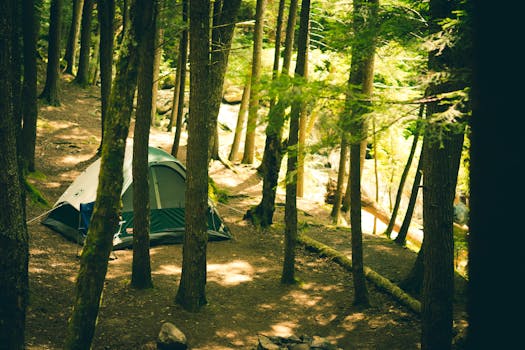
Free stock photo of forest, trees, adventure, camping
Choose Flat Ground
The most important thing to look for when searching for an optimal campsite is flat ground because it could mean the difference between a good night’s rest and waking up to nightmarish surroundings. You are more likely to achieve a comfortable night’s sleep in areas strewn with pine needles, sand, grass or dirt, rather than littered with rocks and roots. Established campgrounds will typically maintain level and safe sites to pitch your tent, often times with streams or meadows as a scenic backdrop. When you find a large and comfortable area, large enough for your tent, use a small rake or similar tool to brush away any sticks, stones or tree branches that might poke you while you sleep. If you do not have a rake, you can use your foot to clean your site of debris. Prior to setting up your tent, assess the condition of the ground by laying your sleeping bag or mattress over the area and testing the comfort.
Avoid Hills
Avoid setting up camp anywhere on a hill, if possible. Whether you’re on the top, bottom or middle of a hill, all of these locations pose a threat to your safety. Rookie campers might mistakenly believe that it’s a good idea to camp in a valley at the bottom of a hill because of the excellent protection from the wind and sun. However, if it rains you may wake up in a puddle of water or worse in a deadly flash flood. Sometimes there is no level ground and you may have to settle for slightly sloping ground. Be sure to position your head on the uphill slope with your feet pointed downhill. If you lie sideways along the slope, you will inevitably roll to one side of the tent, pressing your body into the tent wall material, creating the potential for getting wet from condensation.
Consider Sun Exposure
Always look for an area within close proximity to a shady spot. A tent positioned in direct sun will become sauna-like. Some tents can be damaged or suffer premature aging by the sun’s harmful rays, so always check for tent care instructions before venturing out into the wilderness.
Consider Wind Exposure
Look for a campsite with a natural windbreak. No matter where you’re camping, try to position your tent so the door is facing away from the wind for proper protection from strong gusts. It will be very difficult to get a good night’s rest if your tent is flapping in the wind all night long. Plus, if you’re positioned facing into the wind, your tent will feel drastically colder because of the poor insulation.
Be Close to Water
Some campers feel it is safer to camp near a water source in case they drain their supply of water. However, this may not be the safest choice. There are a couple of reasons for this.
1. Camping too close to a water course can be dangerous if there is rain and a flash flood washes your site away.
2. Camping too close to water can contaminate water supplies. Many established campsites are sited 100 feet or more from a water source.
With this in mind, keep your campsite close, but not too close, to a water source.
Camping in the Forest
Forested areas are popular sites for camping. Many developed tent sites will be flat and designed for tents. Backcountry sites will need a little more consideration. Most developed sites will have harder packed soils and will need sturdy stakes to keep the tent grounded. Forests have a diversity of soil types. Some soils are hard to penetrate with stakes and other soils are loamy and will not hold stakes well. These soil issues show up more in backcountry settings. Do a little research on forest soil types to be assured you have the appropriate stake.
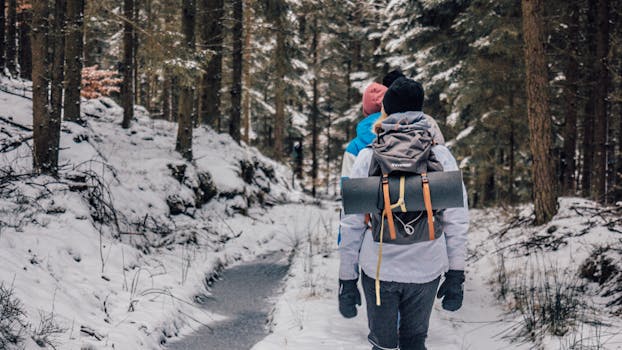
Camping in the Snow
Two People Walking in Woods With Snow

When camping in the snow, if there is fresh deep snow, avoid choosing a campsite near trees laden with heavy snow loads which may drop off in wind or during warmer daytime temperatures. Additionally, in mountainous terrain, avoid bowls and slopes that are prone to avalanche. Stay well back in the trees and up slope from the bowl’s base. Once you find a suitable spot, use your snowshoes or skis to tamp down the ground to create a solid, firm surface. Winter weather conditions may vary from place to place, but it’s always safest to purchase a 4-season or winter tent for proper protection against snow and high winds in exposed tent sites. If you will be camping in deep snow, a snow stake can be a good accessory.
Don’t Leave Your Mark on the Land
In order for everyone to be able to appreciate Mother Nature’s gifts for many years to come, remember your environmental responsibilities. Dispose of your waste properly and do not leave any trace of your visit, on your campsite when you leave. As a general rule of thumb, don’t leave your “footprint” on the earth.

Wild Camping Tips and Kit List

The first rule of Wild Camping club is...  actually really simple! Leave No Trace: if you take it in, you carry it out. What is wild camp...