
Showing posts with label wild. Show all posts
Showing posts with label wild. Show all posts
Thursday, 18 October 2018

Saturday, 16 June 2018


Thursday, 14 June 2018
The Only 4 Things You Need to Survive in the Wild
If you want to know how to survive in the woods or wilderness, then the first thing you need to know is this: always be prepared. You don’t want to be caught without supplies. Never go for even a “short walk” in the woods without bringing a fire starter, knife, water, and rain jacket. Even if you don’t plan on going into the wilderness, you still need to be prepared with survival gear. Keep a car emergency kit in your vehicle in case you break down on remote road. Keep a bug out bag packed in case you need to flee.
But you can’t always be prepared for everything. Take the case of Autumn Veatch, the teenager who survived a plane crash and then days in the wilderness – despite having no supplies and being injured.
It isn’t just plane crashes which could leave you stranded in the wilderness with nothing. You could go for a hike, fall into a river, and have all of your gear wash away. Or you might get abducted by a nutcase and have to escape your abductor through the woods (yes, this has happened many times). The bottom line is that you need to be prepared for anything by knowing how to survive in the wilderness.
You Only Need 4 Things to Survive in the Wild
Unless you are injured or sick, there are just 4 things that you need in order to survive in the wild. Yes, only 4!
- Water
- Shelter
- Food
- Warmth
Hopefully you will have survival supplies to help you get these 4 things – like having emergency food and water rations, a tent for shelter, and matches so you can make a fire to stay warm. But, if not, don’t despair. You’ve got a lot more resources around you than you realize! If you are ever lost in the wild with nothing, just follow these steps.
1. Find Water
The first thing you need to survive in the wild is water. You can only go 3 days without water before dying, but you’ll be extremely dehydrated long before those 3 days are up. Hopefully you can find a stream or creek to drink out of. If you can’t find a ready supply of water, then you can use these tactics to get water:
- Collect Dew: Take your shirt off and press it onto the ground to collect dew. You can then wring the dew into your mouth or into your water bottle.
- Drag a Piece of Cloth Behind You: There is a lot of water in the woods on plants. Drag a piece of cloth behind you (or wrap it around your legs and walk through thick brush). The cloth will collect the moisture and you can wring it out into your mouth.
- Follow Ants: If you see a train of ants going up a tree, it is probably because there is a cache of water in a groove in the tree.
- Travel Parallel to a Mountainside: If on a mountain, cross it by staying parallel. Mountains usually have streams going down them so you are likely to come across one eventually.
- Dig for Water: If you dig, do so at places like dried-up streams and areas with a lot of lush foliage.
Read this post to learn more ways to find water in the wilderness.
And remember that water from lakes, streams, and rivers should always be purified before you drink it, even if it looks clean! Read this post to learn how to purify water in survival situations.
2. Make a Shelter
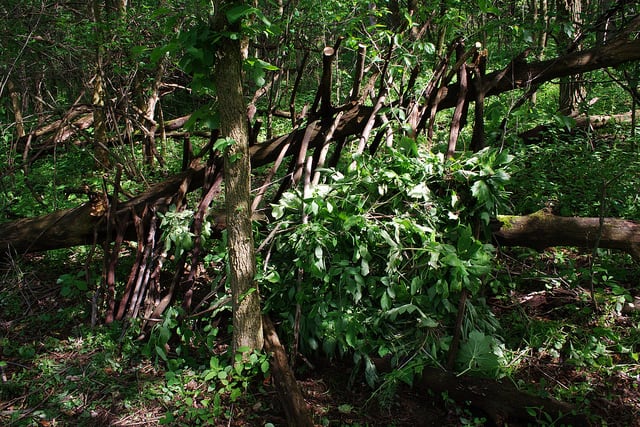
You will need a shelter to protect you from the elements. A shelter can also help protect you from some wild animals as they are more likely to attack you if you are in the open. Making a survival shelter in the woods is actually fairly easy. Remember to have your shelter made before it gets dark!
My favorite shelter for how to survive in the woods is the “fallen debris shelter.” You just need to find a fallen tree. Then pile some large branches against it to act as a shelter wall. Then you fill in the gaps with smaller branches. There are many other ways to make shelters in the wilderness though. Read this post to see survival shelter designs.
3. Stay Warm
Temperatures can drop really quickly in the woods, so you better prioritize warmth. Staying warm is actually just as important as food for survival. And, if you are cold, then your body is going to require more food.
A well-built survival shelter will help you stay warm by trapping in your body heat. But you do other things to improve your warmth.
One of my favorite stories about how to survive in the woods is that of Susan O’Brien. She survived a night in the woods by burying herself in dirt to stay warm. Dirt is a great insulator for when you don’t have a blanket. You could also use fallen leaves, pine needles, or other debris.
Another way to stay warm is to make a fire. But, if you are lost in the woods without matches or a lighter, then this is going to be problematic. Unless you are some sort of wilderness MacGyver, don’t even bother trying to rub two sticks together. You’ll just end up with 2 warm sticks. Save your energy and snuggle up in your debris bed instead. Or, if you absolutely must make fire, then try these methods of making fire without matches.
4. Find Food
There is actually lots of food in the wild – so long as you know where and how to look for it. In survival situations, these would be your primary options for food:
- Wild animals
- Wild plants
- Insects and bugs
Sorry to break it to you, but catching a wild animal for food is a lot harder than it seems. Even if you have gear, it is really difficult! The one exception to this is if you are stranded near some sort of lake. Then you should try one of these methods for fishing in the wilderness.
The better option for wilderness survival food is to eat bugs. Yes, I know this probably seems gross to you, but most bugs are edible and actually very nutritious.
As for eating wild plants, never eat a plant unless you are 100% sure it is edible. If you eat an inedible plant, you could end up with diarrhea, and that will kill you a lot faster than hunger! In desperate situations, you can use the universal edibility test to tell if a plant is safe to eat.
Subscribe to:
Comments (Atom)
Wild Camping Tips and Kit List
The first rule of Wild Camping club is... actually really simple! Leave No Trace: if you take it in, you carry it out. What is wild camp...

-
The first rule of Wild Camping club is... actually really simple! Leave No Trace: if you take it in, you carry it out. What is wild camp...
-
How to Start a Campfire: Ultimate Guide Me make fire. Fire good. Fire bring warmth and cook food. Our relationship with fire spans back...


