The 5 Ws of survival are a mnemonic device to help you identify safe spots for shelter, but they are also good for just general survival awareness. Here they are:
THE 5 Ws OF SURVIVAL:
Water:
Look for: Areas with clean water nearby. These areas provide hydration and food, as well as a possible path to civilization.
Avoid: Damp, marshy ground. Camping too close to the shoreline in case of changes in water level. Lowlands, like canyons, that are prone to floods.
Weather:
Look for: Keep an eye on signs of changing weather, and seek shelter before the weather gets bad.
Avoid: Areas that are open to hazardous weather. Don't camp out in the open, or on top of hills. Don't camp in a place where fog settles. Don't camp in places that act as natural lighting attractors if storms are likely. Avoid areas where avalanches are likely.
Widow Makers:
Avoid: Camping beneath large, dead trees and snags with large, high limbs. You don't want to be in the path of a falling limb or tree that weighs hundreds of pounds. Also avoid areas with thick brush, lots of exposed branches, or lots of knotty roots. You don't want to trip into your fire or put out an eye at night.
Wildlife:
Look for: Areas with abundant sign of small game for hunting and trapping, and there is often edible vegetation and water nearby.
Avoid: Animal dens. Areas with large game trails — you don't want to startle a moose or bull elk that's passing by. Areas with sign of dangerous animals, like fresh bear scat or the stripped bark from moose. Areas with active hazardous or nuisance insects around — brush piles for arachnids and centipedes, stagnant water for mosquitoes, and keep an eye out for wasp nests and ant colonies. If you live in a place with venomous snakes, avoid areas where they may sun themselves.
Wood:
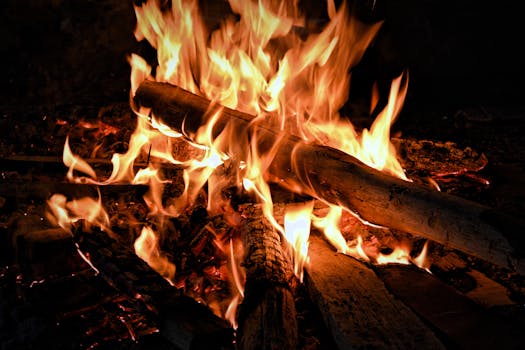
Look for: An area where fuel is abundant and easy to harvest.
Avoid: Areas where wildfires are likely, or easy to start.
There are a lot of things that you could possibly spend your time on to get yourself ready in case you’re lost in the wilderness while hunting or checking out your bugout route. I debated how many categories I wanted to have but I think I came to a decent compromise. Here are the top six skills you should learn now, before you find yourself in a situation where you need to use them.
They’re not the only skills you need but you have to start somewhere. For example, I left out Navigation. It’s an important skill but not as critical as the ones below. In most cases, you should be sitting still and waiting for help but If I were to make this the Seven Survival Skills you should learn now, I’d put navigation next. On the off chance you really need to be traipsing off into the wilderness, you’ll need to navigate. The problem is that every hour you spend learning how to navigate is an hour you aren’t learning how to keep yourself alive that day. You don’t have an unlimited amount of time, so you have to prioritize things. I’d rather be someone who knows the list below first and then starts working on other things like navigation and plant identification after they get these down. Navigation is an everyday skill that you need when you’re in the wilderness so you don’t need to survive. It’s a survival skill only when you messed something up – like navigating in the first place. Not saying you shouldn’t learn navigation – you should. Just doesn’t do much good to know how to walk your ass out of the woods for three days if you die the first night. Once you have these 6 covered, consider navigation as well as several other skills such as making cordage etc.
That being said, since we don’t know what situation you’re gonna be in, navigation, or any other skill not listed here, may be the most important one to learn to keep you alive someday. You really need to know what you’re prepping for and rebalance as necessary. If you know you’re heading out into somewhere that you may not have rescue coming, you need to pull navigation into your required learning. Or whatever else may be able to help.
Obviously, each of these categories could fill an entire book so I’m just gonna explain why I chose each and give a few examples to get you started.
There are six top skills you should focus on learning. You should also pack your bugout bag and EDC with equipment to help you with each of these skills:
Fire
Water
Shelter
Food
First aid
Signal
Fire
The first survival skill you need to know is how to make a fire. Why? It’s hard to know exactly which skill is the most important in any situation but in general, I think making a fire is the most important. With a fire, you can keep yourself warm, purify water, see in the dark, cook food, signal for help, make tools, sterilize surgical equipment and protect yourself from critters. Having a fire is also a huge psychological advantage. Plus, it’s a manly-mans skill to know.
You should learn at least three ways to start a fire. If you’re heading out to an area and know this in advance, you should learn how the local people use local resources to start fires there. One of the best people to learn this from are native people who’ve been there for hundreds of years. Actually, this goes for all of these skills except maybe signaling for rescue.
A big part of having a fire is actually building your fire site so it’ll not only catch, it’ll stay lit. You need to know the basics of how to build a fireas well as some local materials that you can use for tinder, kindling and fuel wood. If you don’t get this part right, it won’t much matter what you use to try to light it.
The first method you need to learn to build a fire is using whatever gear you bring with you. Hopefully you have a bugout bag or at least an EDC kit. Hopefully you’ll at least have a lighter. A stormproof lighter is a better choice than a regular one because, well, I’m sure you can figure that one out. You should also carry some kind of ferrocerium rod with magnesium that you can flake off. You should always have a cheap 99 cent lighter as a backup because they’re just hella cheap and work in most conditions.
Here’s a video to show you how to use a ferrocerium rod, also called a fire steel:
You need to learn at least two other methods of how to start a fire. Since I don’t know where you’re gonna be when you need to start a fire and your lighter/rod isn’t available, I’d suggest learning how to start a fire with a fire bow and with a hand drill. They’re both a lot of work so go for the lighter if you have one.
How to start a fire with a fire bow.
How to start a fire with a hand drill.
A must-have item in your pack should be a cheap fresnel lens. They’re only a few bucks and about the same size and weight as a piece of paper. I like these so much I did a whole review on them.
Water
The next skill you need to have is how to get water you can drink. Depending on your circumstances, this one may actually be more important than getting a fire. You can go 2-3 days without water but you’ll start degrading long before that. You should be thinking about your water situation as soon as you figure out you’re screwed.
If you have a fire then boiling your water is usually the best way to make it drinkable. It’s not a 100% solution but it’s pretty close. If you don’t have a container that you can put water in and sit in the fire, heat up rocks and drop them into your water.
If you have a plastic bag, you can collect water from plants.
With a little more work, you can create a solar still, which works off the same principal.
In case you don’t have anything, you should at least learn how to make a debris shelter. They cost less effort than most shelters as long as you have something available in the area. They won’t stand up to heavy winds though.
Food
Once you’ve gotten fire, water and shelter, you probably want to be thinking about food. You may be able to go a month without food without dying but in addition to the incredible amount of suck there is without eating for several days, you start losing energy to do things. One of these things is thinking. If you don’t have food in your belly, you’ll eventually start making mistakes a lot more often.
Hopefully you brought some MREs with you or at least some kind of emergency rations. I also keep a small container of olive oil because you can’t beat the amount of calories it packs per ounce and it can be used for other things.
If you don’t have food with you, you’ll have to find some. If you have a river, lake, or ocean around, fish are one of the best foods to go after. Obviously, you can make a hook and may be able to find some kind of line and some bait but a basket is usually a better option. Here’s one way to make one using vines.
For small animals, a snare trap is a great thing to learn because it’s not too difficult, can work if placed in the right spot, and you’ll probably be able to find material for. You need to do it a couple times so you know how each piece works in the system. I’d suggest putting it on a path where you can see small animals go through or making a trail funnel with some logs or stones to force them to go where you want.
You should also become familiar with the plants and animals in whatever area you’re thinking about going into. Plants are the safest and simplest way to eat but you have to know what you’re doing. I don’t care what they taught you about the Universal Edibility Test though, it’s crap. You shouldn’t be eating something if you don’t know what it is.
Here’s another pretty simple redneck mousetrap that you can use for more than just mice. I don’t know who originally filmed this gif (let me know if you find out) but it’s pretty much everything you need to know to make one yourself. The concept is pretty simple. Just use what you have available even if you have to dig a pit and put a smooth stick across it with a coke can or something:
First aid
Hopefully you’ve brought along a first aid kit. Even if you did, you still need to know how to use it. I’d suggest getting EMT certified if you can. If you don’t have the time or inclination to do that, at least get good book on survival medicine and study it.
For the most part, you need to know the basics of keeping a wound closed and clean, setting and immobilizing broken bones and identifying/treating for shock, hypothermia and heat exhaustion but you need to learn more if at all possible.
Signal
If you’re stuck out in the wilderness, hopefully you were smart enough to let someone know where you’re going and when to expect you to make contact. Or, you may be out there because your car broke down or your plane crashed. In any of these cases, your best bet is to sit tight and wait for rescue. That doesn’t mean that it’ll be easy to find you, even if they know where to look. You need a way to signal someone passing through that you’re there and need some help.
The big key is to be noticeable. If you can’t stay out in the open, put something out in the open that they’ll notice. Try to use movement, color and shapes that don’t fit in the area. Try to make it unusual. If you’re in the US, do things in groups of threes like three logs laid out in a field or three rocks together. In the UK and the Alps, use six.
Also consider building signaling into your equipment by doing something like sewing a rescue signal panel into the inside of your jacket or have a way to hook it onto the outside of your tent.
If your bag has a ham radio, try 156.8MHz or 2182kHz. You’ll want to save your battery so just pop up on the radio occasionally or if you hear or see anyone. Get as high as possible. The BaoFeng UV-5R is EXTREMELY cheap. It also has frequencies on it that you don’t need a license to use.
Because they use aircraft for search and rescue, it’s a good idea to have a way to communicate with them. A signal mirror is a pretty good thing to have because in the daylight, it’ll allow you to do just that. They don’t take up too much room in your bugout bag and can even fit into your EDC (are you getting the idea yet that you should have an EDC kit and bugout bag already figured out?). By the way, EDC means Every Day Carry. It’s what you have with you at all times during the day that you don’t ever set down.
Here’s an old WWII training video on how to use one.
If you’ve built a fire previously then a signal fire is also a good idea. The key is to have it ready to go when you see or hear someone and have it in a place that they’ll notice.
There are a lot of different things that you can do to prepare for being stranded in the middle of nowhere but the key is to start preparing now. You may not have any equipment you need (but hopefully you at least have a knife, lighter and a flashlight) but with the right knowledge and skill (some of this stuff requires practice), you’ll do fine. If you’re like me, you like to read and research things that you learn. I can only go over so much in an article but a book like SAS Survival Handbook, Revised Edition: For Any Climate, in Any Situation has a LOT of good information in it. It’s the best one I’ve found so far to teach you how to do these things.
If you want to know how to survive in the woods or wilderness, then the first thing you need to know is this: always be prepared. You don’t want to be caught without supplies. Never go for even a “short walk” in the woods without bringing a fire starter, knife, water, and rain jacket. Even if you don’t plan on going into the wilderness, you still need to be prepared with survival gear. Keep a car emergency kit in your vehicle in case you break down on remote road. Keep a bug out bag packed in case you need to flee.
It isn’t just plane crashes which could leave you stranded in the wilderness with nothing. You could go for a hike, fall into a river, and have all of your gear wash away. Or you might get abducted by a nutcase and have to escape your abductor through the woods (yes, this has happened many times). The bottom line is that you need to be prepared for anything by knowing how to survive in the wilderness.
You Only Need 4 Things to Survive in the Wild
Unless you are injured or sick, there are just 4 things that you need in order to survive in the wild. Yes, only 4!
Hopefully you will have survival supplies to help you get these 4 things – like having emergency food and water rations, a tent for shelter, and matches so you can make a fire to stay warm. But, if not, don’t despair. You’ve got a lot more resources around you than you realize! If you are ever lost in the wild with nothing, just follow these steps.
1. Find Water
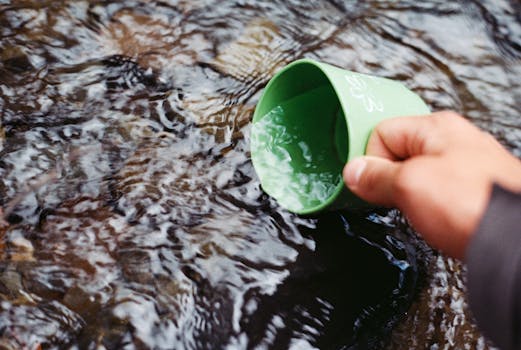
The first thing you need to survive in the wild is water. You can only go 3 days without water before dying, but you’ll be extremely dehydrated long before those 3 days are up. Hopefully you can find a stream or creek to drink out of. If you can’t find a ready supply of water, then you can use these tactics to get water:
Collect Dew: Take your shirt off and press it onto the ground to collect dew. You can then wring the dew into your mouth or into your water bottle.
Drag a Piece of Cloth Behind You: There is a lot of water in the woods on plants. Drag a piece of cloth behind you (or wrap it around your legs and walk through thick brush). The cloth will collect the moisture and you can wring it out into your mouth.
Follow Ants: If you see a train of ants going up a tree, it is probably because there is a cache of water in a groove in the tree.
Travel Parallel to a Mountainside: If on a mountain, cross it by staying parallel. Mountains usually have streams going down them so you are likely to come across one eventually.
Dig for Water: If you dig, do so at places like dried-up streams and areas with a lot of lush foliage.
And remember that water from lakes, streams, and rivers should always be purified before you drink it, even if it looks clean! Read this post to learn how to purify water in survival situations.
2. Make a Shelter
You will need a shelter to protect you from the elements. A shelter can also help protect you from some wild animals as they are more likely to attack you if you are in the open. Making a survival shelter in the woods is actually fairly easy. Remember to have your shelter made before it gets dark!
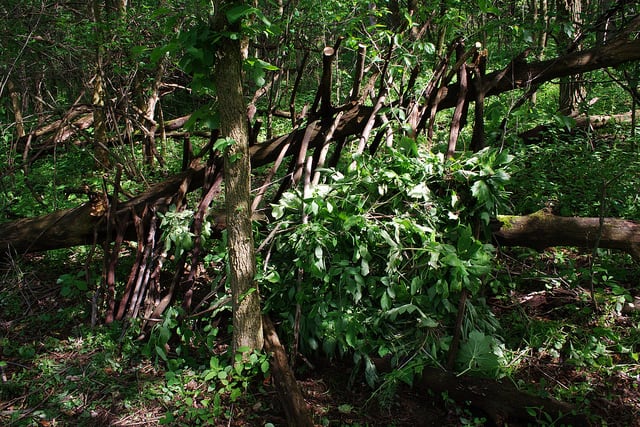
My favorite shelter for how to survive in the woods is the “fallen debris shelter.” You just need to find a fallen tree. Then pile some large branches against it to act as a shelter wall. Then you fill in the gaps with smaller branches. There are many other ways to make shelters in the wilderness though. Read this post to see survival shelter designs.
3. Stay Warm
Temperatures can drop really quickly in the woods, so you better prioritize warmth. Staying warm is actually just as important as food for survival. And, if you are cold, then your body is going to require more food.
A well-built survival shelter will help you stay warm by trapping in your body heat. But you do other things to improve your warmth.
One of my favorite stories about how to survive in the woods is that of Susan O’Brien. She survived a night in the woods by burying herself in dirt to stay warm. Dirt is a great insulator for when you don’t have a blanket. You could also use fallen leaves, pine needles, or other debris.
Another way to stay warm is to make a fire. But, if you are lost in the woods without matches or a lighter, then this is going to be problematic. Unless you are some sort of wilderness MacGyver, don’t even bother trying to rub two sticks together. You’ll just end up with 2 warm sticks. Save your energy and snuggle up in your debris bed instead. Or, if you absolutely must make fire, then try these methods of making fire without matches.
4. Find Food
There is actually lots of food in the wild – so long as you know where and how to look for it. In survival situations, these would be your primary options for food:
Wild animals
Wild plants
Insects and bugs
Sorry to break it to you, but catching a wild animal for food is a lot harder than it seems. Even if you have gear, it is really difficult! The one exception to this is if you are stranded near some sort of lake. Then you should try one of these methods for fishing in the wilderness.
The better option for wilderness survival food is to eat bugs. Yes, I know this probably seems gross to you, but most bugs are edible and actually very nutritious.
As for eating wild plants, never eat a plant unless you are 100% sure it is edible. If you eat an inedible plant, you could end up with diarrhea, and that will kill you a lot faster than hunger! In desperate situations, you can use the universal edibility test to tell if a plant is safe to eat.
Survival techniques are a-plenty, but regardless of which specific one, there are 5 Basic Survival Skills that everyone who ventures into the Outdoors should understand and be fully aware of their potential need and use. This is a just brief outline, not a full explanation of all the requirements and items required in each category. One of the most important elements to survival is between your ears, your brain. Of all survival techniques, the most important is DO NOT PANIC, use your wits and practice all elements of the 5 basic survival skills before you may need to rely on them.
Basic Survival Skill 1: FIRE
Fire is the king of survival techniques! Fire can purify water, cook food, signal rescuers, provide warmth, light and comfort, help keep predators at a distance, and can be a most welcome friend and companion. As a survival technique, it is one that is essential. Each and every person who ventures into the Outdoors should have a minimum of two ways to start a fire with them, one on their person at all times and the other with their gear. A few small fires provides more heat than one large fire. Collect firewood you think you will need for the night and then collect the same amount again, experience shows you will need it. Conserve fuel by making a "star fire"; where the ends of large logs meet in the fire only, push inward as more fuel is needed. Make a reflector from your SPACE BLANKET on the back wall of a shelter to reflect heat of your survival fire to your back, sit between fire and back shelter wall.
Basic Survival Skill 2: SHELTER
SHELTER is the survival technique by which you protect your body from excess exposure from the sun, cold, wind, rain or snow. Anything that takes away or adds to your overall body temperature can be your enemy. Clothing is the first line of shelter protection, have the right clothes for the right environment. Always have a hat. Try and keep the layer closest to your body dry. Layers trap air and are warmer than one thick garment. Do not expend energy making a shelter if nature provides one. Practice building a quick lean-to shelter in case you can not find your campsite, do not wait until you need to make one. Use a SPACE BLANKET to prevent dampness or to insulate your shelter or to wrap yourself up in a sitting or squat position to concentrate your body core heat.
Basic Survival Skill 3: SIGNALING
SIGNALING is unique among survival techniques in that it gives you the means and ability to alert any and all potential rescuers that you are in need of HELP. Fire, flashing light, bright color markers, flags, mirrors, whistles all will help you be found. Three fires in a triangular form are a recognized distress signal. Carefully bank your signal fires to prevent igniting surrounding area. Use regular signal mirrors only when you can see a plane, or people in the distance. Use EMERGENCY STROBE light at night to help attract attention from those that may be in the area. Make smoky fire with organic material over the fire during the day to attract attention. Lay out ground to air signal in open field, S.O.S. from rocks, logs or colored clothing, whatever will be seen against the background. Most search and rescue parties use aircraft as a primary method of sighting.
Basic Survival Skill 4: FOOD/WATER
FOOD/WATER are vital towards your survival. Ration your sweat not your water intake. Try to drink only in the cool of the evening. You can live up to three days without water. DO NOT eat plants you do not know. Never drink urine. Always assume that you will need extra food and water when you plan your trip. Pack energy bars and candy in your pockets at all time, just in case. If possible boil all water 10 minutes plus one minute for every 1000 feet above sea level. Strain water through your handkerchief to remove large particles. Try to drink only in the cool of the evening. Never wait until you are without water to collect it. Have some poly zip bags to collect and store water. Never eat any wild berries that you are not sure of what they are. You can catch rain water in your SPACE BLANKET by laying it out in a trench.
Basic Survival Skill 5: FIRST AID
FIRST AID as a survival technique is not just the basic medical needs, it is the primary way in which you act to survive. DO NOT PANIC, remain calm and do what you have to do to take care of YOU. STOP means Sit, Think, Observe, and Plan. It is the most intelligent thing you can do when you realize you are lost or stranded. The most important element is to keep your brain functioning rationally, this is basic first aid for survival. Analyze your needs before every trip, create a medical checklist and carry a small personal kit with you at all times. Most survival situations require only dressing for small cuts, bruises and personal medication needs, make sure you know what you have with you and how to use it. Do not over pack, pack what you feel you will need to carry with you at all times. Concentrate on being found, pack a picture of your family in with your gear to remind you of the reasons to remain calm and to survive. Prevent hypothermia by insulating yourself in a SPACE BLANKET.
First published on Get Ready Industries. Article reprinted with permission. GetReady! Industries has lots of great ideas and products for being prepared for an emergency. We thank them for sharing this very "laymans" basic survival techniques guide.
So we've dealt with where to go and how to make yourself comfortable for the night. But one cannot operate on fresh air and a good night's kip alone, or not for very long at least.
So your first priority is water. Often overlooked and under-consumed on expeditions. I have found people are especially prone to dehydration in cold climates. In the desert heat everyone is very aware of the problem and is disciplined about drinking. But when you're cold it seems less pressing. Hydration is key to staying healthy on trips, short or long, everywhere in the world. But for the purposes of this blog we'll assume you're wild camping in the UK.
You have two choices: a) take it all with you - ok on short trips or if you're traveling by vehicle e.g. kayak or car, or b) collect along the way.
If you're taking it all with you, bear in mind a litre of water is 1kg. For cooking and drinking in 24 hours where you're working hard in the day you could be looking at 5kg. Personally, with the state of my knees and back, I don't want to carry any more weight than necessary. If you are traveling by some form of vehicle then you can carry the weight dependent on the vehicle i.e. I'd happily carry more in a kayak vs a bike and a car vs a kayak. I use water storage bags a lot as their flexibility allows me to cram them into awkward spaces (e.g. behind the seat of my kayak) and they also diminish in size as you use up the water unlike a hard case bottle. You can even get fittings for them to turn them into showers and if you select a black one, as black absorbs the heat from the sun well, leave it out all day and you'll have a hot shower... although this may not work so regularly in Britain.
But since we're assuming you're UK based for this trip I have some good news. It rains a hell of a lot here so water is seldom a scarce commodity. This means you can collect on the way.
The first thing to bear in mind is the best place to store water is in your stomach so if you find a good source drink your fill before filling up whatever carrier you have. This means you'll leave your water source fully hydrated. I would also say fill up whenever you get the chance rather than waiting until your water bottle has run dry then trying to find a refill spot.
When your deciding how much water to carry it's a compromise between how much you'll need (affected by how hard you're working and the environmental conditions), how much weight you're happy to carry and how far it is between likely refill spots. You may decide to carry nothing if you're walking through streams every 10 minutes or three litre bag if you know you'll see nothing all day. You can also consider your destination. If I know that when I finish I can fill myself with fluid I'm happier accepting a certain level of dehydration through the day and carrying less water. Personally I'd recommend between one and three litres depending on the length of day, weather and number of potential water-stops. I like to carry at least one of my water containers easy to hand with a drinking tube, like the Camelbak type. If you have to stop, take your pack off and get a bottle out for a drink the chances are you won't bother. The easier you make it for yourself the more likely you are to drink. And hydration is key.


 so I’m just gonna explain why I chose each and give a few examples to get you started.
 is a better choice than a regular one because, well, I’m sure you can figure that one out. You should also carry some kind of
  . You should always have a cheap 99 cent lighter as a backup because they’re just hella cheap and work in most conditions.
 . They’re only a few bucks and about the same size and weight as a piece of paper. I like these so much I
  in my bugout bag but I know most people prefer the
  . You should look at both. I even keep a MINI
 or at least some kind of emergency rations. I also keep a small container of olive oil because you can’t beat the amount of calories it packs per ounce and it can be used for other things.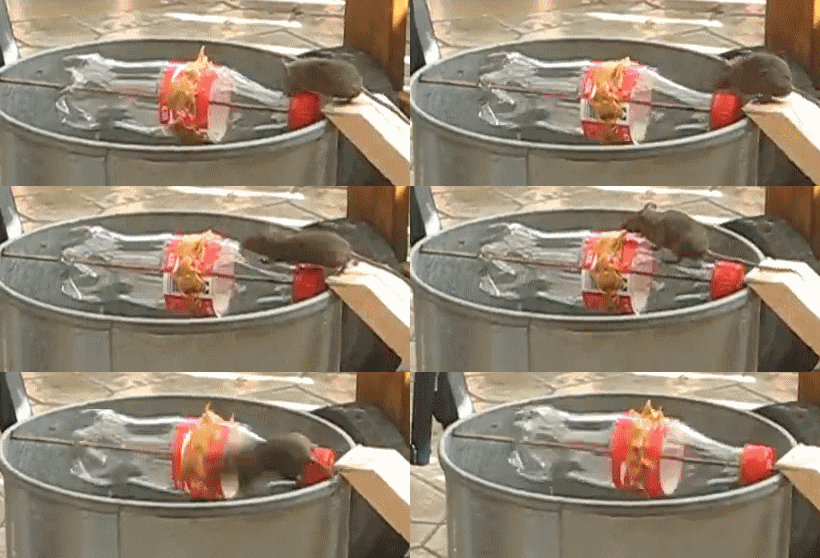


 . Even if you did, you still need to know how to use it. I’d suggest getting EMT certified if you can. If you don’t have the time or inclination to do that, at least get
  and study it.
 into the inside of your jacket or have a way to hook it onto the outside of your tent.
 is EXTREMELY cheap. It also has frequencies on it that you don’t need a license to use.
 is a pretty good thing to have because in the daylight, it’ll allow you to do just that. They don’t take up too much room in your bugout bag and can even fit into your EDC (are you getting the idea yet that you should have an EDC kit and bugout bag already figured out?). By the way, EDC means Every Day Carry. It’s what you have with you at all times during the day that you don’t ever set down.