Unless you are a survivalist, you are probably not aware of the Dakota Fire Hole, and even some of you who are adventurers may not know about this gem. Sometimes referred to as the Dakota Fire Pit, this way of building a fire is superior over all others. In fact, most people who try one for the first time, never go back to other fire building methods.
The Dakota Fire Hole uses less firewood and fuel to keep it going, even though it may take longer to build and require more effort. It is well worth it in the end when you realize how efficiently it works. The fire is hotter, it requires less maintenance, and is safer than other fires. It is also easier to cook with and has limited smoke. When you want to stay hidden this is a big plus, in addition to the pit concealing the fire flame.
Location
The location in which your build your fire is important. You want soil that is sturdy but soft enough to dig into.
Do Not try to build in …
–Rocky dirt
-Wet dirt
-Water filling up hole
-Dirt with thick tree roots
-Dry and loose soil
Building Your Dakota Fire Hole
The Materials:
–Shovel or stick to dig with
The Hole:
–Dig a circular hole, in grassy dirt, that is about 10 to 12 inches around.
-Dig about on foot deep, and pull the grass plug out to save for later
-At a foot deep, dig a few inches wide going in all directions. This will make room for longer fire wood.
-Now you have 12 foot wide hole that goes down a foot and then gets wider to about 15 inches around.
-The neck is the chimney, and the wider part is for the firewood.
The Airway
–This is one of the most important parts of the Dakota Fire Hole and what makes it so efficient.
-Determine wind direction by licking a finger and holding it up to the wind. The side that dries fastest is the side the wind is coming from
-The airway will be built on the side from which the wind is blowing.
-At about a foot from your chimney hole, dig a 6 inch wide circular hole. Dig down more than a foot, angling toward the base of your Dakota Hole, and intersect it by digging into it. You should not be able to place your hand in the airway hold and see it appear at the base of your Dakota Hole.
-Add kindling wood to the base of your Dakota Hole, filling it partially.
-Start the fire, preferably with a FireSteel. It will be harder with another kind of lighter.
How It Works
Hot air rises up the chimney creating a suction that pulls air into the airway tunnel, feeding the fire. Since it’s build on the windward side of the Dakota Hole, there will be sufficient wind.
With oxygen continually feeding the fire, it burns at a hotter temperature and more effectively than fires that sit on top of the ground.
You will use less wood to keep it going and the heat is funneled upward towards you.
Cooking
You can easily cook on the Dakota Fire Hole by placing a flat rock partially over the hole to use as a cooking surface. If you have camp gear for cooking, you can place a grill over the hole, or use pans on the hot rock.
Cleanup
This is where the dirt plug comes into play. Shovel dirt into the hold to cover the fire, which will smother it and put it out. Then place the dirt cap on top.
Summary:
A Dakota Fire Hole is great for camping or for survival in the wilderness. When using for camping, you can use your own cooking gear. If you are in a dire situation where you are hiding out and do not want other people to find you, this fire creates the least amount of smoke and the flame is hidden from view at night. When you clean up, there is no trace that you were ever there. The dirt cap hides everything, and you can re-use the hole at a later time.
A fire is essential to any camper or survivalist. It provides warmth and cooking ability. It is important to know how to build a safe fire, and also to learn how to keep it going. You don’t want to be expending all your energy feeding your fire which is why the Dakota Fire Hole is one of the best choices in fire making. Once it is built it is pretty self sufficient, with the airway feeding the flames which burn hotter and longer than a conventional fire. Always be safe and never build a fire near wild fire risk locations.
Me make fire. Fire good. Fire bring warmth and cook food.
Our relationship with fire spans back to ancient times. Not only did it make the preparation of food more palatable, it lowered the risk of bacteria being consumed such as E. coli. It also provided warmth and protection to our early ancestors.
In this post, you'll learn six ways to start a campfire. And a whole lot more. Here's what we'll cover in this ultimate guide.
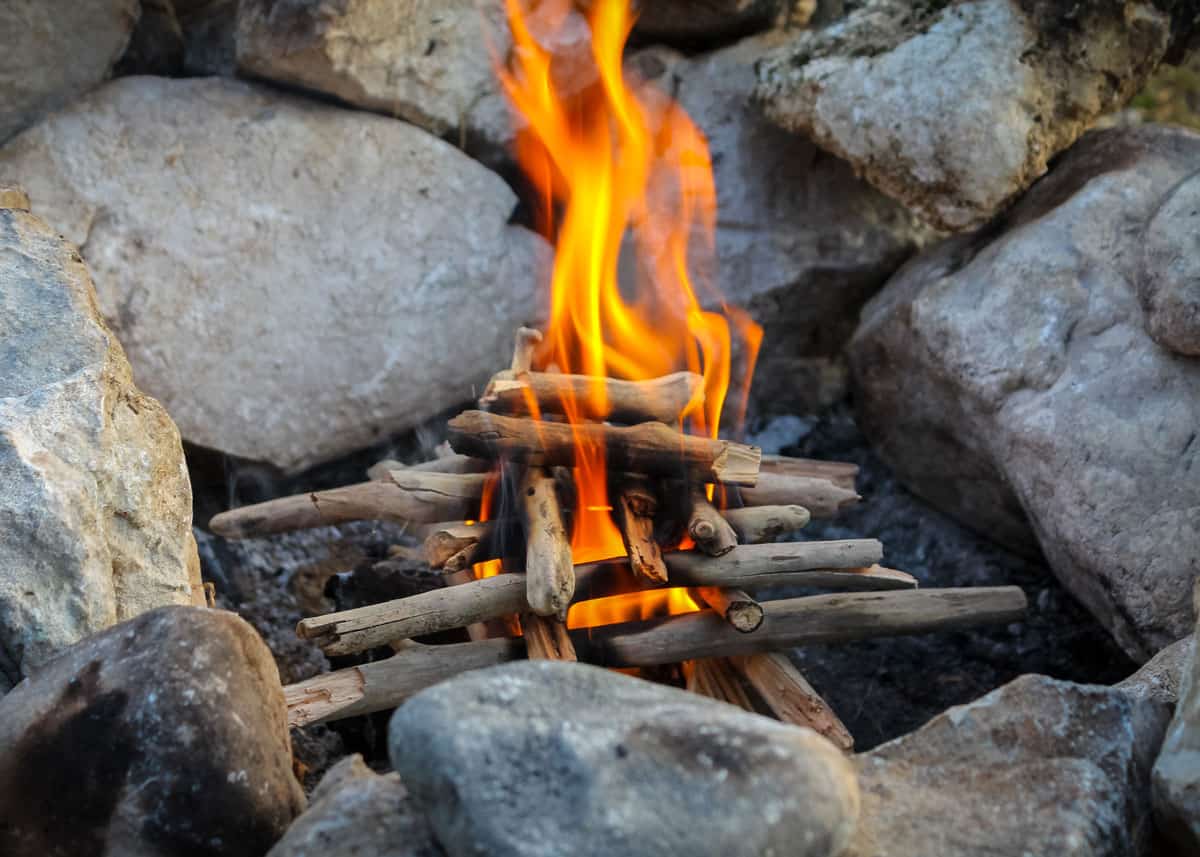
1. Classic Teepee: Best for Marshmallows and Storytelling
This is a good option for cooking snacks on the campfire – but isn't the best for actually cooking a meal.
Here's how to do it: Lay the kindling over the tinder in a shape of a teepee, leaning up against each other. For the first three or four, use smaller pieces of kindling and stick them into the ground for support. They shouldn’t be larger than twigs at this stage. You can then build up larger pieces of kindling over the top. Lean some extra smaller kindling pieces against the downwind side of the fire, with the upwind side left more open through all of the layers.
After a few layers slowly building up the size, add a few pencil sized sticks to the structure and dig these into the ground for further support. Some fuel sized pieces of wood can go on the outside. Once the structure collapses, the log cabin or cross design can be used to build up on top of it.
Pros: Burns very hot and works with wet or green wood
2. Lean-To Campfire: Best for Beginners and Windy Weather
This is an easy fire to make and it works well on windy days.
Here's how to do it: Push a long piece of kindling into the ground so that it is sticking out at an angle over the tinder, pointing into the wind. Lean tiny pieces of kindling on the tinder bundle, smaller pieces of kindling onto the larger piece of kindling to create a lean to effect over the tinder, and then another layer of large kindling over the first layer. If you like you can then add another support stick and another couple of layers of kindling on top.
Pros: Super easy to set up. Great for windy weather.
Cons: Doesn't give a good coal bed (not great for cooking). And won't generate much heat.
3. Log Cabin: Best for Cooking a Meal (Low Maintenance)
This is a great fire for cooking. And it's an easy setup.
Here's how to do it: Surround your pile of tinder with kindling, stacking pieces at right angles like you are building the walls of a cabin. Place smaller pieces of kindling on top. Then around this structure, lay two pieces of fuelwood on opposite sides, then two slightly smaller pieces of fuelwood parallel on the other two sides.
Continue laying smaller or shorter pieces to form a cabin or pyramid shape. Have extra kindling ready to drop into the centre when it’s collapsing or when holes appear to fill them, until the outer edges catch fire.
Pros: Great for cooking (creates hot coal bed) and low maintenance
This one goes against traditional logic. Usually, a fire is built with the tinder/kindling on the bottom and then built up from there. In the upside down fire, you do just as the name suggests.
Last summer, a friend told me about it – and it sounded like a joke. But he built it and it worked perfectly. And because the large logs are on the bottom, there is nothing to crush the fragile new fire. And you won't have to add any wood for hours.
Pros: Burns for a long time, without maintenance. Somewhat fool proof campfire.
Cons: Takes some setup time and doesn't require maintenance (you know you like to play with the fire).
This is not your traditional campfire. To make the rocket stove, you'll need to drill two holes in a large log. One vertical and the other horizontal so that they meet in the center. The vertical serves as a chimney and the horizontal is for air flow.
Pros: Great for cooking, level surface for pot/pan. Requires limited fuel.
Cons: Requires tool for drilling and a piece of cut firewood.
6. Dakota Fire Hole: Great for Windy Days and Leave No Trace
This is the most unconventional campfire in the list. It works great on windy days and when fuel isn't plentiful.
Here's how to make this campfire: Dig two holes about 10-12″ in diameter. One hole will be for the fire/fuel. The secondary hole will serve as the chimney. These two holes need to be close enough that they can be connected by the horizontal underground tunnel. This allows air and fuel to reach the fire at the bottom of the hole.
Pros: Burns hotter, with less fuel and less smoke than a traditional fire. It's easier to clean up when you're done – just fill in the hole. You'll need a digging tool.
Cons: Takes time to prepare and it can't be used in every setting (rocky, sandy, or root-filled soil).
Smoke in the eyes will quickly take the fun out of a campfire. There are a few easy things to do that will reduce (even eliminate) a smoky campfire.
Why a campfire produces smoke: Smoke is unburnt fuel. To reduce smoke, increase the oxygen to the fire. Also, use dry, seasoned wood for a cleaner burn.
Here's what you need to know, to make a smokeless fire:
You need fuel, air and heat to start a fire. Remember that heat rises so when you are lighting the fire, you should light it underneath the fuel so that it can rise up into it. So make sure that you place your lit match under your tinder so that the heat will rise up from there and catch the tinder and the kindling.
You should also light the fire with the fuel upwind from the flame. As you have already constructed the wood with the wind direction in mind, you should already know where the wind is coming from. You can position yourself between the wind and your fire to act as a windbreak, as too much wind can put out the fire. Finally, hold your match in placerather than throwing it into the fire. If you throw it in it is more likely to be extinguished by the journey or be snuffed out by dirt, and you will go through a lot more matches.
Alternatives to Matches
If you have no matches, you had better hope you have something else! If you don’t, then let’s get back to the caveman basics.
There are a number of different ways to start a fire using only nature’s tools. Honestly, none of them are easy but if you must, there are these options for you to try.
Friction: 2 Methods
Fire by friction causes the fuel to heat up to the point of combustion temperature and ignite. This temperature is about 800˚F and so you can imagine it is not easy.
The presence of moisture is going to be the biggest cause of resistance to this method. If it is humid you will find this a lot harder, but if it is dry and you have very dry wood it is possible. Ideally, you want one piece of wood that is harder than another, and you want wood without too much resin, otherwise, the wood will become polished as you go. Any of these methods should be used once you have things ready to go and are in close proximity to the tinder pile so that any early fire is easily transferred.
You will need to choose which option to use, I would recommend one of the following two:
Fire Plow (Friction Fire Starter): You will need a plow board of softer wood that is flat, a couple of inches across and a couple of feet long. You will also need a plow stick that is harder, thinner and sharpened at the end. Cut or rub a depression about 6-8 inches long in the plow board; the snugger that the plow stick will fit into this the better while still being able to run up and down smoothly. Position the board steady either by leaning on it, holding it between or across your legs, and point the plow stick into the board at a 60-degree angle while pushing it forward with a downward pressure. Once you have reached the end, release the downward pressure and return to the beginning. Repeat this movement back and forth quickly, creating wood dust at the end of the trough. Ensure that each stroke ends at the same spot to gather dust there. Once the wood dust eventually combusts, it can be pushed into waiting tinder and developed from there.
Hand Drill (Friction Fire Starter): Choose a straight stalk or stick for a drill, about 18-24 inches in length and ideally as smooth as possible, with no side branches. Smooth this drill of all roughness as you will be rubbing between your hands and do not want to damage your palms. Next, find a suitable piece of wood to use as a hearth board, this will be a fairly flat piece of wood about an inch thick. Cut a small depression in the hearth board within which to place the drill stick. Hold the hearth board firmly in position, with your knee perhaps, and place the drill stick in the depression and twirl to ensure it is the right fit. Carve a notch into the center of the depression so that the wood dust can accumulate here. Continue to twirl the drill stick between your palms, returning your hands to the top of the drill every time they reach the bottom. When you see the wood dust start to smoke, transfer it immediately to your kindling.
Electricity: 9V Battery and Steel Wool
If you don’t have matches, but you do have batteries and some steel wool (you never know what you may have in your car) then you can set the steel wool on fire by connecting it to the batteries to form a circuit. Once it is smoking/on fire, immediately transfer to the tinders.
If you are forced to start a campfire using wet wood, then this is still possible, but a bit more challenging. As long as the wood is old, dead wood, it will be dry inside and the key will be burning off the water on the surface to get through to the dry wood underneath. To do this, you will need to burn a much hotter fire to start with, which will mean burning a lot more tinder and kindling.
If you are using logs from a log pile, make sure you find the driest logs on the inside of the pile to improve your chances of getting a fire going with the least effort. If the ground is wet, you can also create a platform with rocks to keep the fire off the wet ground.
You'll need lots of tinder and kindling. You should be able to find dry tinder somewhere, it’s important that you do – as without dry kindling this definitely won’t work. Perhaps in a big pile of leaves or under a tree or even an old newspaper from your car. Other bizarre but useful items that may help start your fire are corn chips, dry spaghetti, steel wool, clothing, toilet paper, or firelighters (you may need this extra assistance when it is wet). You can make kindling from a larger piece of wood or log by shaving bits off and using the drier wood inside. However you source this kindling, make sure that it’s dry and you have a lot of it.
When it’s wet, it’s best to use the teepee method of fire building that I described earlier as it will allow for more air flow and will dry more pieces of wood more quickly. Once you have your fire structure ready, start the tinder burning; you may need to blow on it to encourage it. As the fire slowly builds, you can slowly place more wood on. Do this slowly and carefully; if you add too much damp wood it may also dampen the fire.
Wet Wood Tip: Have plenty of wood nearby the fire, close enough to allow the fire to warm and dry the wood. However, always make sure that you keep fire safety at the top of your agenda at all times, no matter what.