Showing posts with label campfire. Show all posts

Sunday, 22 April 2018

How to Choose Wood for Campfires

Believe it or not, the secret to good campfire cooking doesn’t start with great equipment or secret recipes, but simply, with your ability to build a good campfire. So, let’s chat about choosing campfire wood a bit more…

What makes good firewood?

The drier, the better! Scientifically speaking, wood is full of small tubes that transport water from the roots into the trunk and then into the branches. These tubes can hold water for weeks, sometimes months after the wood has been cut.
If the wood is still full of moisture, it won’t burn to its full potential. Energy from the fire will have to refocus on drying the wood first which is wasteful, and the smoke and fumes from green wood is a stronger pollutant.
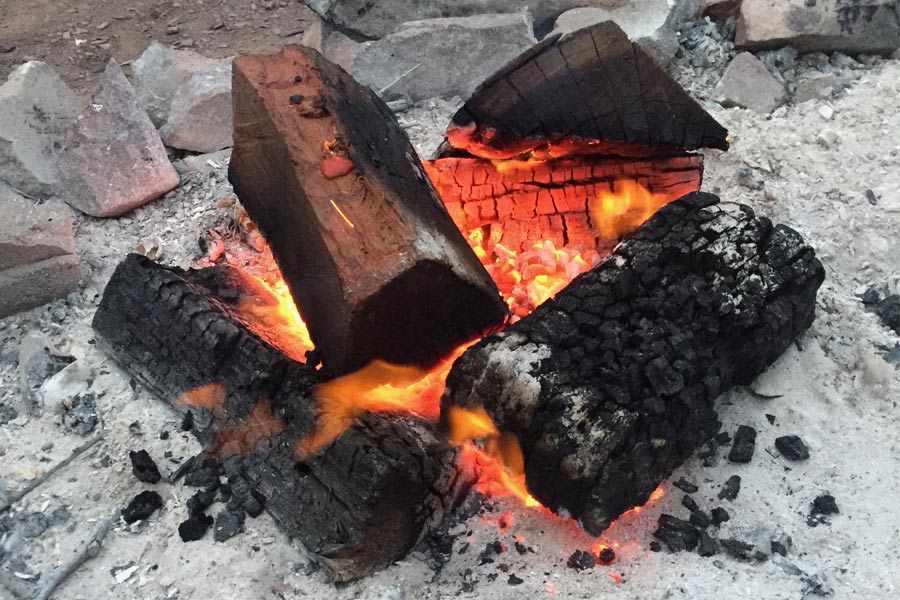
Logs burning into coals on a campfire
The right wood = hot coals ready for some serious campfire cooking. Image: Ben Trewren. 

Looking for Natural Firewood

Whenever you’re looking for firewood in Australia, it’s going to depend ultimately on what is available in your local area. The key is to get your hands on firewood that is not only dry but dense.

Wood available state to state

Across Australia, Jarrah and Wandoo are the species of choice in Western Australia. In Tasmania, Brown Peppermint is considered the best, and in Queensland, Ironbark and Box are the preferred choices. The most popular though is River Red Gum which is the easiest to find in South Australia, Victoria and southern NSW.
Knowing the available species is only a small part of the adventure, as selection also depends on what you are using the wood for, as each species has its own burning rate, flame, coal and ash generation.
For example, River Red Gum is an excellent slow burner, but it doesn’t burn with a lot of flame, so it’s more optimal for cooking. Some species such as Turpentine and White Stringybark don’t produce a lot of flame – so they’re more suited to a wood oven for example.

Test what works for you

Finding firewood that’s perfect for your needs can often be challenging – but never impossible! My recommendation is to try and test locally available firewood to see what works best for you. Alternatively, you could research what species are available in your area of adventure and then use resources such as this one to determine its suitability as firewood.
Also, make sure you do research so you can be certain that you can collect wood in that area – that way you know you’re not disturbing native vegetation or wildlife habitat.
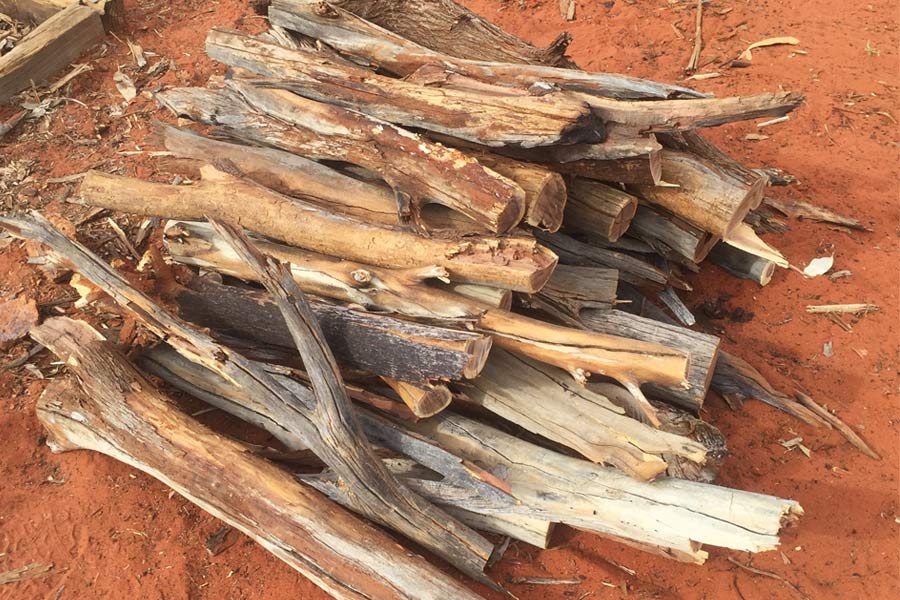
A selction of wood ready for a campfire
A nice selection of wood ready for a campfire. Image: Ben Trewren. 

Purchasing Man-Made Firewood

New to the firewood market is the introduction of man-made firewood called Eco-Logs. Basically, Eco-logs are manufactured from sawdust and shavings that have been mechanically compressed to form a solid log.
By utilising waste material, man-made fire logs help to reduce unnecessary felling of plantation timber and the destruction of habitat for Australian fauna.
There are several benefits of Eco-Logs over natural firewood. Firstly, they can be safely used as a concentrated fuel source, and they contain less than 10% moisture which results in more heat on a weight-for-weight basis.
Man-made firewood is also very dense, which means you burn fewer logs to achieve the same output, and lastly, their compact size makes them easier to store and transport.
The concerns with Eco-Logs compared to natural firewood is that they come with a cost, you need to transport them to and from the supplier, and they don’t develop significantly hot coals.
Ekologs next to a cooker
Man-made firewood is an environmentally friendly and space saving option for campers. Image: Ekologs.

How to Select Firewood

Having decided that natural firewood is what you’re after, here are the best tips I can offer when selecting firewood:
  • Try and pick (or chop) wood to size so logs easily fit within the fireplace.
  • Look for dark to grey coloured wood – this signifies that the wood is older and drier.
  • Get a feel for the weight of the wood. Ideally, the wood should feel light which means little to no water.
  • Knock logs together for a hollow sound and look for wood with cracked ends – this means the wood is dry!
  • Select wood with the bark missing or pulling off. Bark needs moisture to adhere to the wood, this is also a good indication that it’s dry.
Wood chopping logs
Safety first! Make sure you know what you’re doing when cutting up firewood. Image: Ozpig Australia.

Cutting Wood

I just want to mention another safety note when sourcing firewood. If you plan on cutting fallen trees and/or chopping up your own firewood, ensure that you are familiar with how to use a chainsaw, wedge, sledgehammer or whatever else your tool of choice might be.
These tools can become dangerous if not used correctly, and inattention can mean a nasty premature end to what should be a fantastic camping trip.

Can I use Railway Sleepers?

Right across Australia, there are many abandoned railway tracks. Many seeing the sleepers as an opportunity for easy, free and large quantities of firewood. However, it’s important to realise that railway sleepers will likely be contaminated by grease, oil, herbicides and/or heavy metals.
The fumes given off when these products are burned can be toxic. Because of this, I’d recommend avoiding this type of wood for campfires.
So, now that you’ve got the basics for selecting wood down pat, you’re next campfire is sure to be a roaring success!

Sunday, 15 April 2018

HOW TO START A CAMPFIRE IN THE RAIN

Huddling up around a campfire with a few close friends on a cool, clear evening is one of the few parts of a camping trip that borders downright luxurious. Though a good campfire may feel like a luxury in the best of circumstances, in the worst it's an absolute necessity. One of the great ironies of camping is that those times when you most need a good fire -- when conditions are cold, damp, and windy -- are the same times that one is most difficult to start. Additionally, the ability to start a fire in adverse conditions is a camping skill that many campers neglect until it's too late.
How to start a fire in the rain

If you're a camper that doesn't already have a plan to get your fire started when conditions are less than ideal, read on and we'll teach you how to start a fire in the rain.

HOW TO START A FIRE IN THE RAIN - RULE #1: LOCATION, LOCATION, LOCATION


The most basic -- and one of the most frequently overlooked -- elements of successfully building a fire in wet or otherwise difficult conditions is to carefully consider exactly where you'll be building it. A good location for your fire will make both building and maintaining it much easier, and will ensure that you don't waste a ton of time and energy on a project that was doomed from the outset. The most ideal location for your campfire will provide protection from wind, rain, and groundwater, any one of which can derail your fire-starting project if you haven't found an appropriately dry and windless spot.
In order to shield your fire from wind, try to build it on the downwind side of a hill and immediately downwind from large obstacles, like rock formations. If no natural windbreaks are available, you can create your own with with a tarp and a few sharpened sticks, sort of like a miniature fence. Keep in mind that sheltering your fire on the upwind side may not be enough, as more forceful winds will often make their way around the sides of the windbreak, still interfering with your fire. To combat this, create a C-shaped windbreak around your fire with the opening on the downwind side.
Sheltering your fire from falling rain is probably the most difficult requirement for a good campfire location, as you'll have to find a way to do so while also allowing the smoke generated by the fire to escape. Large evergreen trees tend to form a good shelter for fire building, as their shape forms a sort of natural roof. The shape of trees like pines and spruces will direct water outward and away from your fire while still allowing smoke to escape. In order to use one as a shelter, crawl underneath its lowest branches (You can cut a few off if necessary, but make sure that the extremities of the lowest branches still touch the ground below. Of course, building a fire underneath a live tree is inherently risky, but a well-constructed and controlled fire shouldn't provide a serious risk in rainy conditions. Just take all the precautions you normally would, like removing all potentially flammable debris from the ground around the fire and ensuring that there are no low-hanging branches directly above the fire.
Protecting your fire from groundwater is probably the easiest of these three requirements to fulfill. Simply build a fire pit with rocks filling the center, instead of just forming a ring around the edges. This will separate your lowest coals from the wet ground below, and allow more air to reach them, helping your fire to burn effectively.

HOW TO START A FIRE IN THE RAIN - RULE #2: FUEL FOR THE FIRE


Now that you've found and prepared a location for your fire, you'll need to find some tinder and kindling to get it started, and some fuel to burn once you get it going. The tinder will need to be something that ignites easily, while the kindling will be small pieces of wood that you can easily light with the tinder. The fuel will be the larger pieces of wood that will become the coals of your fire.
You should always carry along tinder on your own camping trips, just in case there's no dry brush or other readily combustible materials nearby. Two of the best forms of tinder for starting a fire in the rain are easily made at home, and won't take up too much space in your pack: Paraffin wax melted into dryer lint or, alternatively, cotton balls soaked with petroleum jelly are both easy to ignite, and will both burn for at least a couple minutes -- long enough for you to ignite your kindling.
Dry kindling shouldn't be too difficult to find even in wet conditions, as long as you know where to look. If you've found a large evergreen tree under which to build your fire, there's a good chance you'll find some kindling there, too. Just look for small, dead branches in the dry area underneath the tree to get your fire started. If you can't find enough kindling there, try looking underneath dead or uprooted trees. While the tops may be wet from the rain, there's a good chance you'll find some dry wood that's suitable for a fire inside or underneath them.
Try looking in the same places that you did for kindling to find larger pieces of wood for fuel. These won't be quite as readily available as kindling, but they also won't need to be quite as dry, since the heat from your kindling will cause some of the moisture to evaporate.

HOW TO START A FIRE IN THE RAIN - RULE #3: LIGHT IT UP


Now that you've found the appropriate location and materials, it's time to get that fire going. As one of the 'Ten Essentials,' you should have a firestarter in your bag, whether it's a lighter, matches, or a ferro-flint rod, or whatever else you choose to us. If you don't currently carry one of these, you should. And -- as always -- make sure to clean up after yourself and ensure that the fire is completely extinguished before leaving the area.

Wednesday, 21 March 2018

Top Tips to Keep Warm when Camping

There’s nothing worse than getting cold when camping. It’s much better to prevent the chills than get cold and have to find ways to get warm again. Below are some tried and tested ways to keep warm when camping:
  • Keep out of the wind – pitch your tent in a sheltered position, wind chill can make it feel much colder than the thermometer shows.
  • Wear a number of layers to ‘capture’ and keep the heat from your body. Make sure the outer layer is waterproof if rain is likely, wet clothes are the worst for making you cold.
  • Make sure you wear your clothing so each layer overlaps. Tuck your T-shirt into your trousers, pull your socks up, let the cuffs of your jacket fit over your gloves, you get the idea…
  • Cover your head and neck. So much heat is lost from these parts of the body that a woolly hat and a neck warmer are essential, also a high zip jacket with hood (or both).
  • Go for a ‘bimble’ – a walk to get the blood flowing and generate some body heat OR just do some light exercise outside your tent (but not too much so that you sweat). The same should be done before getting in your sleeping bag.
  • Sit near the campfire – but not too close!
  • Make sure you eat and drink enough. The body uses food to generate heat and being hydrated will aid good circulation. This can be a tricky one to get right as you don’t want to have to keep getting up in the night to go the toilet. Generally camping tends to use up lots of energy so forget that strict diet for a couple of nights, burn off some calories by collecting water from the tap and keeping your camp tidy!
  • When going to bed don’t expect to wear some thin pyjamas like you do at home. It’s probably going to be too cold to strip off anyway. Just take off your outer layers and maybe put on an extra pair of socks. Change your underwear etc. later the next day when it’s warmer.
  • When you wake up the next morning the sooner you put your coat and boots on and start moving about the sooner you warm up – don’t forget a nice cup of tea and some porridge!

Wild Camping Tips and Kit List

The first rule of Wild Camping club is...  actually really simple! Leave No Trace: if you take it in, you carry it out. What is wild camp...