Showing posts with label tarp. Show all posts

Thursday, 31 May 2018

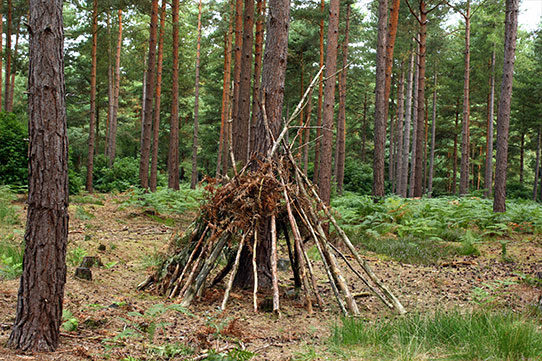
How to Build a Survival Shelter
How to Build a Survival Shelter

survival-shelter
Being a “survivor” has captured the imagination of millions of TV watchers. But a survivor is much more than a TV fantasy. A survivor is someone prepared to live—and live as healthfully as possible—when life far from home doesn’t go exactly as planned.
Being prepared to survive in the outdoors starts with knowing what to be prepared for. You can live days without water and weeks without food. People who don’t survive in the outdoors most often die from losing their body heat, not necessarily from starvation or dehydration. You need to be able to start a fire. And perhaps most importantly, you need to be able to build a shelter to stave off wind, rain and snow, and to keep your body heat trapped where it belongs: near your body.
Here are the keys to taking shelter in the wilderness:

DRESS WISELY

Your first line of defense against the elements is the “shelter” you choose to wear. If you wear layers of synthetic material or wool, and carry a shell of windproof, waterproof material, you are ready for anything. You’ll trap your body heat instead of expending it on the outside world.

THE RIGHT SPOT

Choosing the best place to build a survival shelter is important. It should be in the driest spot you can find. Nothing sucks out body heat faster than wetness. If it isn’t too cold, build a shelter on high ground. Breezes will help keep the bugs away, and you’ll be easier to see if a search party passes nearby. If a cold wind is blowing, choose a spot sheltered by trees. But don’t build in the bottom of deep valleys or ravines where cold air settles at night.
cocoon.jpg

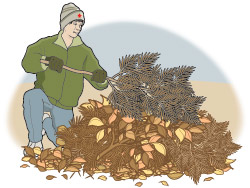
THE COCOON

If it’s almost dark and you can hurriedly collect dry debris (leaves, pine needles, bark) from the forest floor, make a pile two or three feet high and longer than you are tall. When you burrow into the pile, you are in a natural sleeping bag that protects against heat loss.
fallentree.jpg

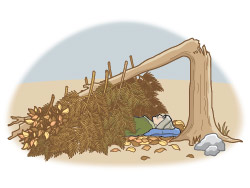
THE FALLEN TREE

The simplest shelter is a fallen tree that has enough room under it for you to crawl in. Lean branches against the windward side of the tree (so the wind is blowing into it and not against it) to make a wall. Make the wall thick enough to keep out wind. If you can build a fire on the open side of your shelter, the heat will help keep you warm.
leanto.jpg

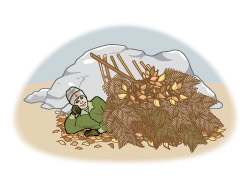
THE LEAN-TO

If you find a fallen tree without enough room under it, or a rock or a small overhang, you can build a simple lean-to. Start by leaning fallen limbs against the object, such as the top edge of an overhang, to create a wall. Lean the limbs at an angle to help shield rain. Cover the leaning limbs with leaves, boughs, pine needles, bark or whatever the forest offers. When you have built a thick wall, you can crawl underneath into your shelter. Remember to make your shelter no bigger than you need to fit you and anybody else with you. The bigger the space, the harder it is to keep warm.
You can also build a lean-to by placing one end of a long stick across a low limb of a tree and propping up the other end of the stick with two more sticks. Tie the ends of the sticks together with your boot laces or belt. Lean more sticks against the horizontal stick. Then pile leaves and other forest debris against the leaning sticks until you have a wall. Once again, a fire on the open side of the lean-to will add much heat to your “room.”
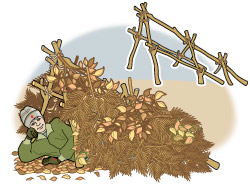
a_frame.jpg

THE A-FRAME

If you can’t make a lean-to, you can make an A-frame shelter. You’ll need two sticks four or five feet long and one stick 10 to 12 feet long. Prop the two shorter sticks up in the shape of the letter A. Prop the longer stick up at the top of the A. Tie the three sticks together where they meet. The three sticks will be in the shape of an A-frame tent with one end collapsed against the ground. Now prop up more sticks against the longer stick, and pile forest debris against the sticks until you have an insulated shelter open at the high end.
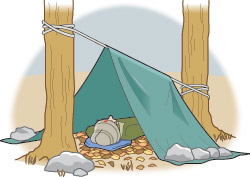
tarp.jpg

A TARP

When you have a tarp, sheet of plastic or Space Blanket with you, and some rope or cord, tie a line between two trees. Tie it low to the ground with just enough room for you to lie beneath. Stretch the tarp over the line. Place large rocks or logs on the ends of the tarp to hold it in place with the edges close to the ground. If it’s snowing, tie the line off higher on the trees. Steeper walls will shed snow better. Now you have an emergency tent.

YOUR BED

Your shelter is not complete until you have made a bed to lie in. Dry leaves work well. Make your bed a little bigger than the space your body covers and at least eight inches thick. When you snuggle into it, you are ready for the unexpected night out.

BAD PLACES TO BUILD A SHELTER

1. Anywhere the ground is damp.
2. On mountaintops and open ridges where you are exposed to cold wind.
3. In the bottom of narrow valleys where cold collects at night.
4. Ravines or washes where water runs when it rains.

Wednesday, 2 May 2018

How To Set Up The Perfect Tarp

ABOVE & BEYOND NEWSGUIDESNEWSYOUR ADVENTURES

How To Set Up The Perfect Tarp

In this article I’ll be teaching you how to set up the perfect tarp – a task that can
 sometime’s be tricky.
That’s because the tarp’s a versatile piece of equipment, and can be set-up a

number of different ways to
 suit a wide range of settings and conditions.
You can use them to make a tent to keep out the wind, or secure them high
 overhead in order to make a canopy to have a fire under in the summer. 
How, where and when you put up your tarp is completely up to you – and
 that’s the beauty of them.
With summer and the warm weather upon us, now’s the perfect time to
spend a night under a tarp –especially if it’s something you’ve never done
 before. However, that said, there can be a bit of a learning
 curve involved which is why summer’s the ideal time for first-time tarp
 users to try it.
In this blog I’m going to take you through my Top 5 tarp configurations,
 teach you how to set up a tarp, and reveal a few of my expert tarp tips
 and tricks. So let’s get cracking: There are three main systems for 
setting up your tarp – ridgeline, fixed point ties and free standing. 
Which of these you use will depend on 
your environment and the elements you’re up against.
For instance, If you’re out on the hills where there aren’t any trees you 
will need to know how to set up your tarp on the ground in a free
 standing set-up, using trekking poles or dedicated tarp poles to provide 
height. The use of a ridgeline is a personal preference of mine and 
essential for larger tarps, while small lightweight tarps can be setup
 with fixed lines on either end, thus reducing weight in your pack. Let’s 
take a look at some of the different options you have when it comes to
 setting up your tarp…

How to set up a tarp in 

different configurations:

  • The A-Frame

A tarp set up in the A-Frame configuration is ideal for use with a hammock
 or when sleeping on the ground. It’s an arrangement that works well in most 
conditions, is simple to set up and gives you plenty of cover from the elements
. It also provides you with more than enough room for a sleeping area and 
work space. A 3m x 3m tarp will be enough for most people although larger 
tarps will be required for a group shelter.
You can set up a tarp in an A-Frame at any height, and with the sides touching
 the ground on cold nights. It can also be set up so you can stand underneath
 it and have it as a kitchen or work area. However, remember to pay attention
 to wind direction when setting out your tarp in an A-Frame and place a
 closed side facing the wind otherwise it will funnel through your tarp at night.
  • The Diamond Configuration

A tarp in a diamond configuration provides a longer, central cover which is 
ideal for use with a hammock. It’s a versatile configuration, giving good
 usable space, but less side cover than the A-frame set up.
A diamond set up can be arranged with two sides on the floor to provide 
you with shelter from the
 elements. However, problems can arise if the centre of the tarp droops. In windy
 conditions your tarp can flap causing you a sleepless night, or pools of water
 can form in saggy areas; so use of a ridgeline is best for larger tarps as it allows 
the middle to be secured to the line.
  • The Lean-to

A one sided tarp set up, or Lean to, can be great for summer use or if you’re
 using an open fire for warmth. It provides a good sleeping area but one
 draw-back is there’s not much work space.
Another problem with this arrangement is it can prove problematic in strong
 winds, as it will act like a sale and bow out considerably due to the large 
surface area.
  • Ground tent

Now these are great options for when you’re out on the hills. They provide 
you with the maximum possible cover, and can be set up to be free standing 
with walking poles or sticks to support the tarp. What this means is 
lightweight camping anywhere that takes your fancy.
You’ll require extra tent pegs for a ground tent set-up too, so make sure you
 pack more than you normally carry. These are the most complex of 
configurations and there are a couple of different ways to go about it, but
 they’re worth practicing. For now though, let’s stick to the basics…

How to set up your tarp – The Basics:

When using one of the more basic configurations from the examples above
 (the A-Frame, Lean-to or Diamond Configuration), the first thing you need
 to do when setting up a tarp is identify a potential site. Ideally, look for 
somewhere with flat ground between two trees, with enough space in between them to
 secure your tarp.
Once you’ve identified a potential site carry out a few quick checks to make sure it’s 
safe. Check the trees you’re securing your tarp to aren’t dead and liable to come 
down on you in the night, and sweep the area for any potential hazards. Look for
 loose tree limbs above you that could fall on you and avoid anything that looks 
questionable.
Finally, check the ground for potential trip hazards by creating a clearing on the
 floor (a root sticking out of the ground can make for an uncomfortable night’s sleep). 
Once you’re happy you’ve found somewhere safe to set up your tarp the process
 follows a basic procedure:
• Set-up your ridge-line
• Attach your tarp to the ridge-line
• Add tension and adjust the ridge-line
• Secure your tarp’s corners
• Peg out the remaining guylines

How to create a ridge-line:

I recommend a 10m cord from DD Hammocks for all ridgelines and suspension of 
tarps. It’s 6mm thick and very strong. Although it’s a little heavier than para cord, 
it won’t cut into your hands and your knots pull out easier. Also, it allows you
 to use Prusik knots in conjunction with your ridgeline, as they run 
more easily on a cord thicker than that used to tie them, while still locking as intended.
When tying your ridge line, I recommend using a Siberian hitch to secure the 
line to the first tree and a trucker’s hitch to provide easy manageable tension
 at the other; both of these knots are quick release making packing your tarp 
away quick at simple. And both knots can be used with fixed lines attached 
to your tarp if you don’t want to use a ridgeline.
Two Prusik knots (created using para cord or proper Fixed Loop Tarp Fasteners)
 left attached to the ridgeline and small carabiners on the tarp allow the tarp to be
 attached to the ridgeline quickly and provide tension through the middle of the 
tarp stopping it sagging in the middle. I always tie a knot in the centre
 loop of my DD tarp so I can adjust the sag in the middle.


Pegging Out Your Tarp’s Guy Lines:

Most tarps come with guy lines ready to attach with plastic tension devices.
 These normally work fine, but in time, can break or slacken off. Replacing
 them with longer cord and a sliding knot or upgraded
device can give greater diversity and rigidity to your tarp and set up.
There are many mechanical devices you can use to quickly adjust the tension
 in your guy lines. Nite Ize make a simple solution called The Figure 9 Carabiner,
 they are stronger than a plastic alternative.
But as with any piece of kit Figure 9 Carabiners and plastic attachments can be 
lost or broken, so it’s worth knowing how to tie a knot that can slide and provide 
tension. Knowledge costs nothing and weighs nothing, so learning how to tie a
 Taut Line Hitch is time well spent. There are other more complex knots
 but the taut line is simple and works well. Other alternatives include:

Top tips for putting up a tarp while 

camping:

1. How to avoid a saggy middle: Tying a simple over hand knot in the centre
loop and clipping it onto the ridge line will avoid a saggy middle.
2. Sand bags: On a beach fill stuff sacks with sand and bury them to provide a
 good anchor for guy lines, the higher the wind the deeper you will have to bury
 them.
3. Opening up the tarp: You don’t always want your tarp to be pitched flush
 to the ground. In betterconditions you can open one (or both) sides up. Loop
 the guy line around a stick or walking pole to raisethe side of the tarp before
 pegging it into the ground. Adjust the height so you can see out from under the
 tarp, you will let more light in and be able to enjoy nature even more!
4. What to do if a tether point breaks on your tarp: wrap the fabric around a marble
 sized pebble or pieceof wood and use a constrictor knot around it to attach the new
 guy line to the tarp.
5. Before you set up your tarp look up. Look for hung up trees, dead wood or anything
 else that could fallon you in the night. I once set up my camp below a wood peckers
 nest, this was great to watch but at 4amwhen they decided it was time to get up I
 wasn’t so impressed.
6. Weave sticks and branches at one end of your A-Frame tarp set up to reduce air flow
 through the tarp, this can make it feel several degrees warmer inside and greatly 
improve your nights sleep.

Try A Tarp For Yourself:

There’s no better way to get close to nature than with a night under a tarp. It’s a totally
 different experience to spending a night in a tent. And a greater connection to nature 
isn’t the only reason peoplelike wild camping with them. They’re versatile, light and
 have a number of different uses – all of whichmake them a great choice for anyone 
serious about spending time outdoors.
For instance, if  you’re backpacking and want to save weight, or if you don’t have the
 space for a tent and poles in your pack, a tarp is the answer. They can be slung up
 over a hammock, used as protectionfrom the elements while you hunker down for 
lunch, or used alongside a tent to create sheltered cookingor kitchen areas.
And of course – they work great as your primary shelter. So
take a look at A&B’s great range of tarps
and open up a whole new world of possibilities for your wild camping trips this summer.

Wednesday, 21 March 2018

Bivi and tarp set up for wild camping

For some, tents are a way to just pretend you are in the outdoors or a way to simulate the security of being “inside” when you are actually outside but if you learn to fully embrace the outdoors, you are in for a totally different experience (and challenge). There is nothing wrong with tents but bivvying is something else.
I’m always keen to perfect the art of bivi bag sleeping. Those looking to go ultralight will often ditch the tent and go for just a bivi bag and tarp setup. I tend to argue that if you have a sleeping bag, mat, bivi bag and tarp then what’s the difference between that setup and a sleeping bag, mat and tent? Poles instead of rope?
Putting this aside, sleeping in a bivi bag can be a great way to camp. You get to be fully secure and warm (and waterproof) but still be properly outdoors to lie by a campfire, stare at the stars until you fall asleep, or socialise with your camping buddies till you all drop off.
The precise configuration of your gear will be dictated by practice and personal choice. I spend odd nights trying out combinations in the garden in all temperatures. This weekend it dropped to 1c in the late evening and there was frost in the morning. Despite this, I had trouble sleeping as I was too hot! This was a new configuration of tarp (just for privacy from the neighbours), no floor covering, bivi on bare ground with Rab down sleeping bag and Jack Wolfskin Wolfmat inside. I had base layers on.

A simple setup with a DD Tarp
The first thing I noticed apart from bivi bags being so much warmer than without – even in a tent, was that I really felt the need to have a floor covering. Not so much to protect the bivi bag, but just so I felt I could relax, have somewhere to put gear down and just not feel completely confined to the bivi to stay out of the mud.
I think the “lean to” shape tarp configuration will work well for me. It only requires one rope line (or two sticks). It’s a basic “L” shape with half the tarp flat on the floor. You have to tuck in to the angle for sleeping but means you have plenty of room for kit and cooking. It doesn’t give the best sky cover so make sure any rain isn’t going to be able to angle in.
The plus and minus to this setup is that both ends are wide open. The plus of this is that you will still get good air-flow which will help take the moisture away from your bivi. Bivi’s are really not easy to get inside either, at least this way you have plenty of space and a clean tarp to sit on as you wiggle in. The downside is you will still be fairly exposed. You could pitch closer to a tree or other obstacle. Instinct will say to close up the foot end more and have the head end open but if camping out, I’d do it the other way around – you want to be facing the bigger exit so you can see out.
The other reason for this shape (other tarp setups are available) is so that the ground moisture can’t rise up to get trapped inside the tarp. It also gives another layer of protection to your bivi and mat inside (if inflatable). You can sleep close to the exposed side so you get a view of the sky. If the weather turns, you just scoot over to the corner side a bit more. Remember, you are in a bivy too, so you’re waterproof anyway.


Lean to tarp
The “Lean To” tarp

Searching online will give you lots of tarp configurations to try out and it’s worth having a couple of plans for different terrain or weather conditions. I first landed on Trailspace.com.
My other favourite is the “tee-pee” which takes a little practice. It requires a central stick and does give you some floor cover inside. You will need a decent sized tarp for this one though. A standard military sized 3 x 1.5m tarp wouldn’t really work and be careful to not make the tarp too taut or the stick will go through. I’m speaking from experience here, and I had to patch it up with the McNett Tenacious Tape. If you’re going to use the Tee-pee often, it’s also worth reinforcing the pole area with tape.
The other variation on this is what I call the half tee-pee. The stick wants to be closer to the front end. Peg out the back/centre of the tarp first to the ground.Then prop up the stick at the front/centre and peg out the front corners so the sides and front at taut. Go inside and pull in the back corners to make two overlapping triangles for your floor. The result is an enclosed end with a floor and an open front. Your head will go inside on the tarp and legs will stick out in the open. It’s easier to setup if you can push the stick into the ground but don’t damage your tarp. The height of the stick and size of the tarp will determine the shape of the shelter so experiment first.

shelter tarp
Shelter tent shape
pulled in back corners
The pulled in back corners crossover to give you some floor space.

I definitely feel more comfortable with the tarp doing something else other than just keeping rain off. “If something’s worth carrying, it needs to have more than one use”. As a rain cover, tarps are very bulky and easy to see at a distance. If you’re using this setup, you are very close to just using a tent and in modern, one man tents, the weight and pack size is not much different either.
You can easily run up to and over £100 with a decent bivi bag that is fully waterproof and breathable. Tarps are fairly cheap though so this is bonus. Anything which is advertised as lightweight where tents are concerned tend to get expensive.
Ultimately as with a lot of camping and survival, it’s about personal choice. A tent is generally more conspicuous. You might not be up to anything dodgy but sometimes it’s part of the fun to go unnoticed! Tents also require flat ground. The beauty of a bivi is it’s really about just chucking it down and crashing out in the great outdoors. You can get hooped bivi’s which look great when coming from a tent, but in some ways they are more cramped as they are small but unlike a bivi bag, don’t move with you, yet you are still inside it. Hooped bags can sometimes be easier to get into though and the frame does keep the bag off your face in bad weather.
Learn to love the tarp. The philosophy of it is the same as with all camping – “There is no wrong way to do it. It’s about having fun.” If it covers you and works for you, then it’s perfect!

Wild Camping Tips and Kit List

The first rule of Wild Camping club is...  actually really simple! Leave No Trace: if you take it in, you carry it out. What is wild camp...