Showing posts with label bivi. Show all posts

Monday, 12 November 2018

Wild Camping Tips and Kit List

The first rule of Wild Camping club is... actually really simple! Leave No Trace: if you take it in, you carry it out.
What is wild camping?
Wild Camping pretty much refers to camping anywhere outside of a recognised campsite. In the UK this can be a legal grey area, as most land is privately owned (the exceptions being Scotland and Dartmoor). If you do have your eye on another spot, we recommend seeking permission from the landowner.
Basic rules for wild campers
Good wild camping practice makes it possible for us to keep getting out there! Wherever you choose to camp, make sure that you always do the following:
  • Carry out ALL litter when you leave, whether it belongs to you or was left by someone else.
  • Leave camp as you found it and remove all traces of your pitch.
  • Camp as unobtrusively as you can. That means away from roads, houses and other habitation.
  • Keep groups small and avoid staying in one location for extended periods – normal etiquette is to pitch at dusk and strike at dawn – or as close as possible to.
  • Keep noise and disturbance to a minimum.
  • Respect the environment and wildlife and don’t pollute
What to take wild camping?
As wild camping covers a variety of circumstances, it's hard to give a brief list of all the kit you might need for your trip. Instead, we gathered all the kit we think you might need on our Wild Camping Kit List, which should help you get what you need for wild camping year round!

The AK team making nature their home in Chamonix
Everyone has their own ideas about wild camping, about how to choose a location, what makes the perfect wild campsite... we decided to ask Alpkiteer Mark Hines a few questions about Wild Camping. As an ultra runner, hiker, stand up paddler, and cyclist, Mark has camped his way around the world in some of the toughest conditions imaginable: he's no stranger to a bivi or night ‘under canvas’. We caught him between trips to share a bit of his experience and knowledge.
Mark, where was your first Wild Camp?
I genuinely have no idea: I was practically an egg when I started camping with my parents. The first time I wild camped was more than ten years ago, and was somewhere in the UK but I cannot recall where!
What’s your preferred set up for wild camps? Does it change according to where you are and what you're doing?
It definitely depends on what I am doing.
I am less likely to bivi if I am on a fast-and-light, multi-night journey in the UK, or if there is a good chance of heavy rain. On those trips I need the space and protection of a tent to ensure I can tend to my feet and dry them out if I need to. 
In contrast, in the sub-Arctic and Arctic I prefer a bivi to a tent for two key reasons. Firstly, it is much quicker to camp with a bivi, which reduces the risk of frostbite, so there is a practical benefit. Secondly, if I am in a tent and there is a clear night, with or without the Northern Lights, at some point I have to zip myself away from it all. With a bivi I can watch the sky until I fall asleep, and that is a real luxury. The same can be said for being in a hammock, and where I know I can find good woodland I will always use a hammock: my favourite set-up for wild camping. The last time I used one was in jungle areas of Assam in northeast India, and it was an incredible experience (some concerns about tigers, rhinos and one elephant that came legging it in my direction were not necessarily highlights!). For me, the best thing about wild camping is being alone and isolated in nature, exposed to the elements and feeling a part of it.

There is an attitude towards camping that it is ‘roughing it’, but I do not agree with this. I acknowledge that a room with a big, comfy bed, heating, and brick walls does offer luxury and security, but that does not mean that camping must be rough. I want my camps to be as comfortable and enjoyable as possible because if I sleep well I will feel better and be able to push myself the next day on the trail. For me, camps are about relaxing, unwinding, and recovering from the day on the trail, so that I am set up to put in a really good effort the next day. The better the camp, the better the journey. As an example, when using my bivi in a woodland area in the sub-Arctic, I could just lay it down on the sleeping mat and sleep, but if I spend a few minutes building-up a spruce mattress I will have about the most comfortable mattress I could wish for and fantastic insulation to keep me warm – even below minus 40 Celsius.

Where was your most memorable wild camp?
Where to begin?! Animal encounters rate very highly. One year in the Yukon I had a wolf come up and start sniffing and poking around the kit on my sled, before sniffing me and strolling off into the night. That was pretty special.
That said, I think the most memorable wild camp was just inside the Arctic Circle in northern Canada near the border between the Yukon and Northwest Territories. I was there as support crew for the 6633 ultra race, and had been booted out of a car on a mountain pass. The area was remote and sometimes subjected to brutally high winds, so the race organiser stationed me there in case a racer got in trouble or wanted to see a friendly face. I set up my single-skin tent as an emergency shelter and stored all my kit inside. I then used a shovel to build up a fairly vast, circular windshield - big enough for me to sleep inside - dug a cold well into the centre, and cut some steps down into it. A coyote came over to inspect my work, before heading off and melting away into the darkness. That night I enjoyed watching some of the best Northern Lights I have ever seen; I just lay in my sleeping bag watching this green curtain of light extending down dozens of kilometres from space, swaying above me and filling half the sky. It was absolutely incredible. I stayed there for half the next day, sitting down and listening to music under a brilliant blue sky, without a cloud to be seen, and the white snow with its crystals shining out like diamonds everywhere. I have had some fantastic wild camps, but that one trumps the lot.

Mark Hines' most memorable wild camp in the Arctic | Image: Mark Hines
How do you choose a spot to camp?
This is what I think about and the sorts of questions I ask myself when I’m getting tired and looking for a place to wild camp:
Check the ground
What is the ground like? Is it flat? Anything that might damage the tent or cause discomfort? Any sign the ground is waterlogged or might be? If in hilly terrain and there is a chance of rain, might water get funnelled towards the camp?
Any signs of large or potentially dangerous animals that suggest this is a spot best avoided (even in the UK I’ve had a stag get furious at me for camping in his woodland, and on another occasion a small herd of cows and horses appeared together because I had apparently chosen their favourite tree to bivi under).
Check the surrounding area
Any danger of falling rocks or trees? Is the area too exposed if there is a thunderstorm? Are you likely to be disturbed during the night or morning by walkers, vehicles or people in nearby towns / buildings? Sleeping close to a river can be lovely, but is the camp in danger if the water level rises?
Plan before you put the shelter up: do you have everything you need?
Do you have access to sufficient water?
What is the bug situation?
Being close to water or in damp areas of woodland will increase the chances of attracting mosquitoes and midges. An area exposed to higher winds will mean fewer bugs.
Do it properly
Time spent ensuring the location and camp set-up are both very good is time well-invested. The reward comes in the form of a better night’s sleep and being in better shape for the next day as a result.

You can read about more about Mark's exploits in our Daring Deeds or at markhines.org 

Saturday, 19 May 2018

The key to successful bivouacking


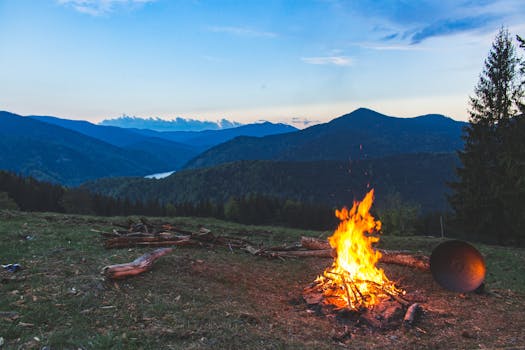
Bonfire Surrounded With Green Grass Field

The preparation for your bivouac starts well before you pitch your tent in
the countryside!
Regarding the choice of equipment, the preliminary information and the
practical advice,
this step-by-step guide will help you enjoy your future outdoor overnight
stays safely.
Sleeping in the mountains is a very enchanting experience. In order to ensure
that your outdoor nights
are as pleasant as possible, here are the key steps to a successful bivouac!

Safety cannot be separated from the preparation process for a mountain
bivouacking excursion

Like camping, there are a number of safety principles and laws associated with
bivouacking Several days
before your departure, we recommend the following:

Check the weather forecast for your destination site.

Make enquiries about the applicable regulations: off-grid camping is highly
regulated and you cannot just pitch a tent wherever you want.

Check your equipment: if you have not used your tent for a while, it is well worth
pitching your tent in order to remind yourself about the procedure and check
whether there are any missing elements.
Everything, including tent pegs, poles, emergency repair kit, utensils for your
cookset and your groundsheet, must be checked with a fine tooth comb.

The choice of location: very important for ensuring a safe bivouac!

Choosing the right location is essential for making the most of the pleasures
of outdoor living. What is your golden rule? Always put the safety before the
beauty of the landscape. The location of your bivouac must be:

a neutral area, that is far away from any cultivated fields (potential movements
of machinery at dawn, damage to seedlings) or areas with animals
(faeces, ticks, etc.) or rivers (rising moisture, insect populations).

a flat piece of land, not only to avoid slipping during the night, but also to ensure
as much comfort as possible and guard against the formation of a puddle
should it rain. Branches and stones located beneath the sleeping area must be
removed.

a surface that is sheltered from wind: in order to avoid any damage caused by
strong winds or storms, which can pick up at night, it is advisable to pitch
your tent facing the mountain. This will prevent ascending gusts of wind from
striking the sheet with full force. A common error is not taking into account
the katabatic wind, which comes from the mountaintops and is caused by
the cold air dropping down the slope. Under the effect of gravity, the gusts
can reach particularly high top speeds.

Our tips for a luxury night spent outdoors:
 
In the mountains, certain details can sometimes make all the difference. Here are
a few practical recommendations that have been tried and tested many times.

Having one torch per person in order to ensure the safety of everyone's movements.

Having an additional water bottle in order to put out the embers of your campfire
when you go to sleep.

Protecting yourself from the cold at night, which can be quite extreme, even in
summer. A good mattress and a suitable sleeping bag (mummy bags, for example,
provide excellent coverage of the body) should do the job. In winter, we recommend
that you place an insulating foam groundsheet underneath your inflatable mattress.

Protecting yourself from the dew at dawn, particularly when bivouacking in the open air.
A waterproof and breathable overbag can prevent this type of inconvenience.
For extra comfort, you can add a liner

Do not arouse the sense of smell of the surrounding animals by leaving leftovers of
your meal near to the tent. Cleaning the cookset and securely storing the provisions
will ensure you have a peaceful night

Make sure that you can make coffee at dawn by slipping your gas cartridge into
your sleeping bag at night.
This advice will prevent the gas from freezing overnight!

Once you have had a good rest and have eaten properly, you'll be ready for
another fantastic hike!

Monday, 14 May 2018

A Beginner’s Guide to Bivouacing

A Beginner’s Guide to Bivouacing

Cliff top bivouac in Cornwall
THIS ARTICLE: Will explain what exactly is meant by “bivouacing” (sometimes spelled “bivouacking”) and how you might go about “bivvying”. It talks about why you would want to bivi, who does it and and where. It discusses different types of bivi equipment and how to deal with common problems.
(Want to buy a bivi bag? See my Buyer’s Guide to Bivi Bags).

Introduction

What is Bivouacing?

Bivouacing (or “bivouacking”) simply means sleeping outside without a tent. That could be as simple as lying down on the beach and closing your eyes for a pleasant night’s kip. Or it could be as complicated as tying yourself to the side of a mountain, wrapping yourself in down and Goretex, and hoping you stay warm enough to see it through until morning.
To achieve a basic bivouac, you really don’t need to read a whole article, you can just take a sleeping bag outside on a nice summer’s evening and sleep beneath the stars. However, for those not yet convinced or wanting to find out a little bit more about the options and the more extreme versions of the humble bivi, read on.

Is it spelled bivi or bivvy?

I have no idea. My hunch is that it’s not really a word (it’s just short for bivouac) so you can spell it whichever you like. I’m going with bivi, bivvying and bivouacing for this article but it’s spelled on all sorts of ways e.g. bivvy, bivvi, bivis, bivvies, bivouacking, bivvied and so on.

What is a Bivi?

A bivi can an item, an action and a place. You might have a bivi bag, that you used to bivi last night at a bivi spot. (That means you can “use your bivi to bivi at a bivi” – one for Joshua Ferris perhaps?)

Why Bivi?

Some of the great reasons for bivvying are more exaggerated versions of the reasons you might camp. Camping allows you to reach wild places and be closer to nature, bivvying does more of the same. Some other
  • Bivi kit is invariably smaller and lighter than camping kit.
  • It is far quicker to set up in the evening and strike in the morning.
  • You can sleep in much smaller spaces – on tiny cliff ledges or between bumps on ground too lumpy for a tent.
  • Bivvying is more discreet than pitching a tent.
  • In good weather, you don’t have the cramped conditions of a tent.
  • You can see the stars every time you wake up.

Who Bivvies?

Anyone who you might camp, might consider a bivi instead.
Bivouacing is particularly common for alpine mountaineers who need to spend a night, or part of a night, out on the mountain but don’t want to carry heavy kit or won’t have room to pitch a tent. Such situations can provide spectacular settings but can also be cold and uncomfortable as the alpinist is invariably striving for the minimum weight in their packs.
Adventure racing and long-distance running might also call for a bivouac as, once again, space and weight in the rucksack become premium.
I’ve used mine with friends walking the South West Coastal Path for many years. It’s so much easier to stumble out of a pub in the dark and find a discreet spot for a bivi bag than it is with a tent.

Where can you Bivi?

With a bivi bag you can sleep just about anywhere. I have slept on beaches and in woods, on cliff-tops and mountain-tops, in car parks and beneath dual carriageways. Some of my favourites are listed here.

Bivi Kit

As stated, in good weather, you can perform a basic bivi with nothing more than the clothes you’re wearing. However, other situations may require some other bits and pieces.

Sleeping bag and mat

What sleeping bag you choose depends entirely on the situation. If you are going lightweight then tiny down sleeping bags can pack to the size of a pint of milk (and weigh less than one). Alternatively, taking warm clothes or a down jacket and just a silk liner is another option to minimise pack weight.
For sleeping mats, cheap foam ones are great. More expensive self-inflating mats save space. Lightweight enthusiasts sometimes stoop to using bubble wrap or even inflating several long balloons to create a lilo.

Bivi Bags

At its most basic, a bivi bag is large sack that you climb inside to provide some protection from the elements. If you think of a body bag then you’re not far off.
(UPDATE JULY 2014: Since writing this guide, I’ve produced a detailed comparison of all the different types of bivi bags complete with sizes, weights and costs. Read it here).
Orange Survival Bag
At the bottom of the pile is the plastic orange survival bag. They cost only a few quid and are totally water- and wind-proof. However, they do not breathe which means that the moisture you give off during sleep will accumulate inside and likely make you wet. (Ronald Turnbull gives an excellent guide to getting the best performance from an orange bag).
Orange Survival BagEx-Army Bivi Bags
These are just large, green Goretex bags with a drawcord at the top. They’re not the smallest or lightest but they are cheap, tough and an excellent place to start. Try Ebay. My wife has one of these as do several of my friends.
Similar alternatives come from Rab’s Ascent bivi (made with eVent rather than Goretex) and Alpkit’s Hunka.
Ex-Army Goretex biviCheap coated-nylon bags
There are a few companies that produce very cheap bivvies made from a coated nylon. They tend to be pretty light and pack down small. The downsides to these are likely comparatively poor breathability and durability, both of which are reasonably significant for the bivouacer as condensation can be a real issue and dragging the bag across rocks and the like is not uncommon.
Cheap coated-nylon bivi
Hooped bivvies
The luxury option is to take a bivi which has one small hoop. This has the advantage of creating space inside and allows you to zip up when it rains and not have the bag flat against your face. It’s a little claustrophobic the first few times but you soon get used to it. Keeping shape also allows better air flow which reduces condensation. I’ve had a Terra Nova Jupiter for over 10 years.
Having a hoop obviously adds weight and requires a modicum more time and effort to set up. You can, of course, use the same bivvy without a hoop (for example if you’re pretty sure the weather’s going to be nice).

Terra Nova Jupiter hooped bivi

Another type of bivi bag are the lighter, non-waterproof types (like Rab’s Survival Zone) that tend to be either used inside a tent as a protection for a precious down sleeping bag and a bit of extra warmth, or when climbing at altitude where it’s likely to be cold and dry.

Beginner’s Bivi Kit

If you want to give bivvying a try without forking out loads then a good place to start would either be looking on Ebay for an ex-army bag or, easier still, visit GoOutdoors. For use in mild weather you can get a self-inflating mat, summer sleeping bag and waterproof bivi for £65 or even less if you get a solid foam roll mat instead (N.B. no affiliation with GoOutdoors, I just noticed how cheap their stuff is).
The Bivi Bag Buyer’s Guide
Tempted to bivouac? Check out my guide to buying a bivi bag. They start from £4 and you can get a decent one from about £25. Read the Bivi Bag Buyer’s Guide now >>

Wild Camping Tips and Kit List

The first rule of Wild Camping club is...  actually really simple! Leave No Trace: if you take it in, you carry it out. What is wild camp...