Showing posts with label fire starting. Show all posts

Wednesday, 17 October 2018

10 Fire Starters You Probably Have At Home

10 Fire Starters You Probably Have At Home

Turn these unexpected items into a cheerful campfire
1. Crumpled Paper Products: Newspaper, paper towels, toilet paper, and scrap paper are go-to items for starting wood stoves and fireplaces. A dry bit of paper can be a lifesaver in campfire building as well. Bonus survival use: Crumpled balls of paper make good insulation if stuffed into your clothing.
2. Cotton Gauze: Raiding the first aid kit for tinder is a sure sign that you’re in an ugly situation. Paper-wrapped cotton gauze is there as a wound dressing, but it’s also very flammable.
3. Tampons: Cotton fiber feminine products serve both hygiene and medical purposes, and when ripped apart they make a great tinder.
4. Plant-Based Cloth: Any dry cotton, linen, or other plant-fiber clothing or cloth can be burned in a pinch. You won’t want to waste cloth if you are in the outdoors and your supply is limited, though. Tear off strips to burn, rather than using the whole item at once.
5. Dryer Lint: This dusty fluff is explosively flammable when it consists entirely of cotton fibers. Just keep it dry and it will light with sparks or an open flame.
6. Wood Shavings: While saw dust is flammable, a small pile of wood shavings will have a looser structure and a better surface-to-air ratio for combustion. If you are a woodworker, save some shavings to build your next fire.
7. Greasy Chips and Snacks: Fritos are not only a delicious snack with lots of calories, but they are a surprisingly good fire starter, as well. Just apply an open flame to the edge of any fatty chip and watch it burn like a torch. Most any chips you have in the cupboard will work.
8. Cardboard: This one is simple enough, but it can also be improved. Soak a little melted wax or grease into the cardboard for a better burn time. The wax will also provide some waterproofing.
9. Plastic Fiber Cloth and Rope: Unless the item has been treated with some flame retardant, plastic ropes and cloth will burn when exposed to an open flame.
10. Cotton Balls: Either dry cotton balls or ones soaked in petroleum jelly will make a great fire starter. The dry ones will burn for 20 seconds or so. Greased-up cotton balls will burn up to 5 minutes.

Wednesday, 25 April 2018

Survival Gear List: The Survival Essentials

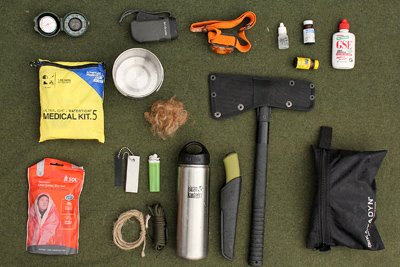
survival gear list items
by Filip Tkaczyk
Not sure what to include on your survival gear list?  Well, here are some helpful tips to making it more manageable.  For starters, you want to consider several possible perspectives depending on the type of scenario you are planning for.  You can choose to include gear that is all modern and relatively high-tech in nature.  On the other hand, you might only include simpler and more primitive gear only.  Oftentimes the best approach is to include some of both. 

First, you want to be sure that any kind of gear you do include is something you are very familiar with.  You want to make sure you are completely confident in using all of the materials on your survival gear list before you actually include it in a pack to be used in the field.  Bringing untested and unfamiliar gear is possibly going to put your life or your family’s life in very real danger. 

Simple tools such as flint and steel for fire making, a knife for carving or a hatchet for splitting wood are great.  Remember, that simple does not mean easy.  Practice using these tools under different conditions, including during difficult weather, in poor light and while cold and tired.
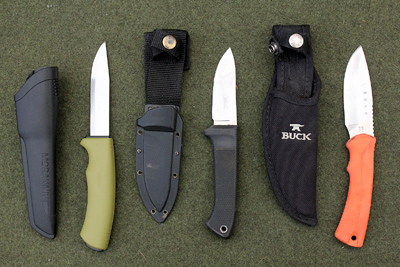
good survival knives
Having redundancy in your survival gear list is also a wise approach.  For example, having multiple tools for making a fire, more than one knife, extra batteries and so on.  This must be tempered with the need to keep your pack or other gear containers light and portable, which brings up the questions of how long will you be counting on this gear?  The type and amount of gear you will need can vary considerably depending on the amount of time you will be out.

Below are two lists that include both high tech and more primitive tools to include on your list and in your packing.

Here is a recommended survival gear list for a short-length wilderness survival situation. 
  • Several fire starting methods: lighter, matches, flint and steel with a magnesium strip.
  • Large, dry tinder bundle in a sealed bag
  • Handheld flashlight or headlamp with extra batteries
  • Fixed-blade knife (or two)
  • Base-plate or lensatic compass
  • Map of location (if you know it ahead of time)
  • Emergency whistle
  • Poly-cord rope (50-100 feet)
  • Variety of sizes of Ziploc bags (for keeping tinder dry, storing food, collecting water, and more)
  • First Aid Kit
  • Large rain poncho (can be improvised into a variety of shelters)
  • Emergency blanket
  • Large stainless steel cup or canteen (for boiling and holding water)
  • Pump filter (for filtering water)
  • Water purification tablets (such as grapefruit seed extract or iodine)
  • Extra warm clothing
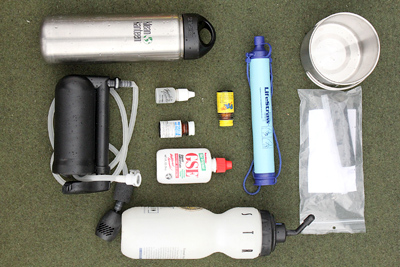
survival water purfication tools
Here are some additional pieces of gear to add to a survival gear list for a more extended survival situation.
  • Hatchet or quality large kukri knife (for chopping and splitting wood)
  • Wool blanket (maintains much of its insulating value even when wet)
  • Fishing line and fishing lures in a small container
  • Wool clothing, especially pants, socks and jacket, warm gloves, cap or beanie
  • A small stainless steel cooking pot
  • Multi-tool
  • MREs (how much you bring is completely dependent on how long you will be out there) or dried food such as MountainHouse meals
  • Bow and drill friction fire set (when you are skilled with this, you can make a fire practically anywhere)

All of this gear starts to add up in weight.  Practice with everything until you feel confident with each item. 
Short term survival is about making it through and finding help.  A wide variety of materials can be utilized for this purpose from a survival gear list and don’t have to be limited to what was suggested here.

Long term survival, also called “wilderness living,” is also dependent on an intimate knowledge of the land, and generally requires the cooperative actions of a group of people as in a tribe or village.  For long-term survival to be sustained, hard-won knowledge must be used. Such knowledge is often passed down from generations of people who have practiced it. 

Wilderness living is about cooperating with others, including all the living beings on the land that sustain life.

Remember the most important survival skill is your knowledge.  Educate yourself on how to survive in the wilderness by taking classes from experienced bushcraft practitioners and survival schools.  Nothing beats learning directly from an experienced instructor and practicing with their coaching.

Friday, 23 March 2018

How to Start a Fire With Different Types of Kindling


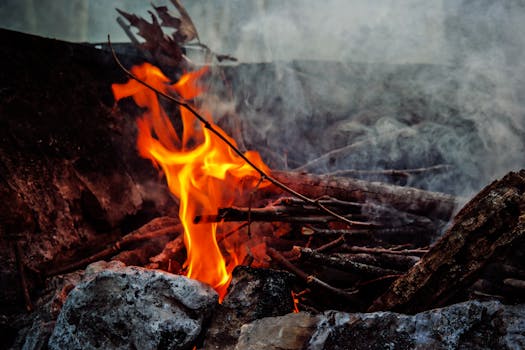
Free stock photo of wood, rocks, firewood, fire


Fire is essential for survival, cooking and warmth. Usually a fire is started with thin or split wood kindling but there are many other kinds of tinder and kindling that can be used if you're in a scrape and cannot locate any small wood.

Find tinder. Kindling tends to be the material used to let larger wood really catch, while tinder is small shavings or shreds of material that will burn hot quickly and starts the kindling burning. Kindling is larger than tinder. Examples of tinder include dry grass, dry bark and down from birds. Once the tinder is burning, you can slowly add the kindling, unless you've already arranged it in a style such as a lean-to or tip over the tinder (see below for links to building the fire). However, there is a fine line between what can be used as tinder and what can be used as kindling––sometimes certain material can be used for both purposes. Some ideas for tinder (some of which might also be useful as kindling) include:
  • Use lint. Pack a toilet paper roll with dryer lint. When you're ready for a fire, pile wood around the lint roll. Light the center of the cardboard roll (exterior) and it'll catch fire and burn outwards, catching on the piled wood as it burns. The beauty of this is that it's making use of items around the house and it doesn't weigh much in your pack. Also note that if you have several of these, they can serve as kindling as well as tinder.
  • Use pine needles. Use pine needles or pinecones to start a fire. Select only dry needles, not green ones, as these won't take as easily. Pile onto the fire in little lots rather than everywhere or it risks smothering the flame.
  • Save and dry small pieces of tree bark. Bark catches fire quickly and will maintain embers for a long time.
  • Use dry debris. Use dry debris from your yard, such as twigs, leaves, and moss to start a fire. Ensure that there isn't too much soil in what you've gathered, as it can prevent fire from lighting.
  1. Find a substitute for kindling. Normally you'd look for dry wood, such as tree limbs, tree twigs and branches, or split wood if at an organized campsite. However, this isn't always possible, so the following ideas are presented to help you in a pinch.
  2. Use your favorite potato chips as a fire starter. If you have a bag of potato chips handy, they can function as a fire-starter due to the fat content of the chips. Light a chip with a lighter or a match and it will burn for approximately 3 minutes. Add the lit chip to a pile of chips on the campfire you've set up (see below for making a fire). While the chip kindling is burning, place light, dry wood on top to catch alight over the burning chips.

  3. Use newspaper. Roll five dry newspapers into a tight tube, tie the tube into a knot, and light the knot on fire. The tight paper will burn slowly, allowing more time for the wood to catch fire.
    • Tying the paper into a knot will prevent the layers from moving around when lit.

  4. Use pine cones. Pine cones are quick to catch fire over tinder (such as pine needles). As well as being suitable kindling, they give off a great aroma.

  5. Make the fire. Once you've assembled the tinder and kindling, you'll need to make a decision as to how to build the fire. There are quite a few ways to build a fire, each having its own utility dependent on where you are, the temperature and weather and the terrain, etc. Here are some articles to follow on to, which will explain how to make a fire successfully:
  6. 7
    Enjoy a night under the stars next to the warmth of your new fire. Keep the fire well stoked by adding new fuel regularly throughout the time of the fire's use.
    • If the fire goes out, sometimes you can restart it simply be shifting around the coals and throwing on some more kindling to catch fire to the existing hot logs on the campfire.
    • Wet wood can be dried out next to a fire; sometimes you'll have no choice.

Wild Camping Tips and Kit List

The first rule of Wild Camping club is...  actually really simple! Leave No Trace: if you take it in, you carry it out. What is wild camp...