Camping wild is not just about camping high on a hill – it’s about finding a place to lay your head for the night which is as much part of the experience you will cherish in two decades when you open up your moleskine as actually getting some sleep. It should bestow on you, if you are willing to sacrifice a little comfort, and to plan a little in advance, an experience almost unparalleled in the world of outdoor pursuits and adventure travel. There are few feelings as liberating, thrilling and rewarding as being immersed in your surroundings in the way camping wild allows you to do, whether those surroundings are a Scottish mountainside, the gardens of an ancient French Chateau or the simple arable land belonging to an Uzbek farmer. In this 3 part guide, Andrew Mazibrada looks at all the essential elements of camping wild, whether on two feet, two wheels or in a packraft.
My first night camping wild was a disaster. I was delayed out of London and paid a taxi driver more money than I care to admit to take me to the start of the trail because of the late hour. The night sky had the unearthly sable colour you might associate with Hades’ underworld and the rain descended in violent, relentless slashes. I walked by the light of a headtorch for an hour before finding a suitable place to camp. And by suitable I mean the only place within a mile that was not boggy or covered by a sheen of thick, muddy rainwater. My dual skin tent pitched inner first and, no matter how quickly I erected the inner, it was soaked before I could get the fly on. I crawled in, the rain dripping off every part of my body. Fortunately, by luck rather design, I had a synthetic fill sleeping bag so, damp as it was, it was still warm enough. I dumped my wet clothes in the porch of my tent and pulled on some warm, dry clothes before slipping into my bag. I was so exhausted that even the thunderous percussion of the rain on the fly was not enough to keep me awake.
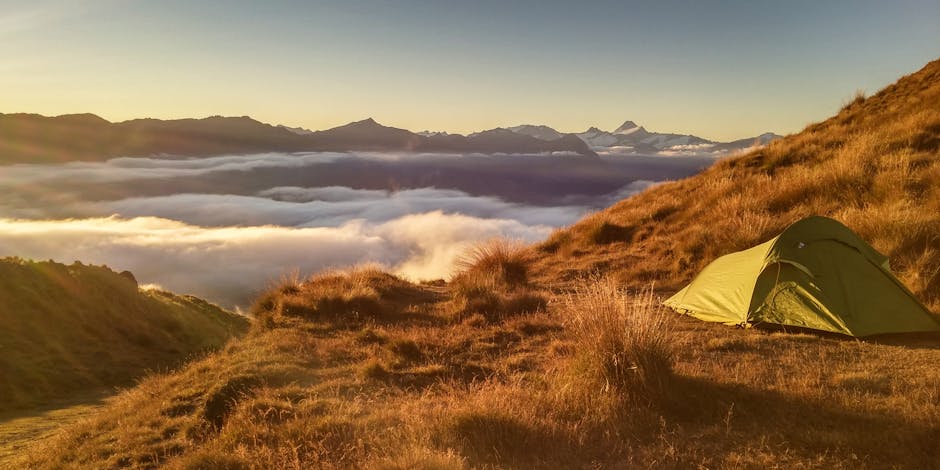
The next morning, I awoke to light inside the tent so bright it almost blinded me. I rubbed my eyes and yanked on the zip. The sight which greeted me I recall as being so majestic, so beautiful, so utterly inspiring that to this day, I wonder whether I will ever better it. Memories are sugar-coated like that. The sun was just rising, casting a crimson veil across the mountains, the forest and the lake in the valley below. The sky was the colour of autumn leaves. I sat in my bag and allowed this sublime vista to erase from my memory the hardship of the night before, cradling hot tea in my hands and watching porridge bubble away on the tiny stove in front of me. I suspect that the panorama was as much a function of the situation as how it actually looked, but in the moment, I was hooked.
WHERE TO CRASH
Let’s be honest: a breathtaking view is the pinnacle of wild camping but the main requirement of a ‘pitch’ is a good night’s sleep. You can’t spend hours looking for the best spot every time but turn your mind to it early enough and you’ll find something memorable. To some, the camp is what it’s all about, to others it is simply a means to an end. Where you choose to camp, for how long and how long you spend looking for the perfect spot will depend on what you want from your overnighter. Either way, for all practical purposes, you will want flat, horizontal ground without major lumps, rocks or holes. You can probably live with a slight slope if that’s all there is, but pitch on the slope so you’re laying head-to-toe downwards. I suggest you lie on the ground first before pitching your shelter – it’s a challenge to find enough level ground in some areas and you should allow at least an hour or so for this whilst you have daylight. Idyllic as they are, level pitches near a water source are often boggy and make sure you take into account the space needed for guylines. Clear the area of twigs and stones to protect your shelter’s groundsheet. If there are two of you, face the porches towards each other – it makes cooking and being sociable that much easier.
You may not even need a shelter – one of the best night’s sleeps I’ve ever had was in my sleeping bag, on a mat laid on a gravelly beach, with only the stars above me. A clear night, without a hint of rain and reasonably warm. The freshwater of a Swedish lake only metres away from me, it was a joy not to be inside a tent. In Scandinavia, you’ll find laavu (Finland), gapskjul or slogbod (Sweden), and gapahuk (Norway). These are open lean-to shelters which provide a roof and, often, a place to light a fire. These are great places to sleep.
Aim for a sheltered pitch if possible, especially if you anticipate strong wind overnight or even a medium wind in cold weather. Pitching on a summit may reduce condensation by encouraging airflow through the tent but good shelter is harder to find. You should pitch the ‘sharpest’ point of your tent towards the wind. This helps the wind bleed off the shelter’s fly, maintains stability and reduces noise.
Eat something before you go to sleep and/or go for a walk. If you’re in the hills, bag a night-time summit but remember your camera if the sun is dipping below the horizon – this is often the best light for landscape exposures. In a township, the late evening is the best time to go explore. If you’re staying on private land with the permission of the locals, think about getting to know them (and bringing a gift always helps). This extra exertion burns calories, as does the energy required to digest the food you’ve eaten – both produce heat. Get into your bag hot and you’ll stay warm. Don’t expect your bag to warm you up if you’re cold already.
“Actually, you’ll be surprised where you can get away with putting a tent, sleeping rough or blagging a horizontal surface! Sometimes, in ‘emergencies’, it’s been fun seeing what’s possible in this regard. I’ve slept in bus shelters, inner-city parks, building sites, roadside verges, subways, empty garages, petrol stations, fishing boats, tramps’ hovels, hotel gardens, under tables, drainage pipes, storage sheds, abandoned buildings — even about five metres from a busy main road in full view of anyone who cared to stop and take a look!”
Tom Allen’s website,
Tom’s Bike Trip, is a superb way to inspire yourself to see the world differently while you camp anywhere.
RESPECT YOUR SURROUNDINGS
You can sleep almost anywhere; the only issues in reality are safety and legality. The former probably prevents you from camping in certain areas of inner cities and the former is as much about respect and engaging with people as it is the lexicon of the law.
For example, camping anywhere without permission is illegal in England and Wales. Almost all the land in England and Wales is owned by someone and you should, in theory, try to seek the permission of the landowner before entering private land (The only exception in England and Wales is Dartmoor where an old statute makes it legal). Wild camping in Scotland is legal. Much of Europe has similar rules to Scotland. When you get out into wilder places the gap between pockets of civilisation increases and few will mind where you camp if you respect your environment. Camping in the wild is tolerated by most if you:
- Plan ahead
- Don’t camp on ground which is likely to be affected once you leave
- Respect wildlife and the your surroundings
- Take out yours, and other people’s, litter
- Keep groups small and be considerate of others
- Camp unobtrusively and quietly and, remember, noise travels further in the hills
- Camp in quiet, rarely used spots
- Don’t stay in one place for more than a few nights
- Don’t light fires if you can avoid it
- Don’t camp right next to a water source and ensure any camp toilet is at least 30m away from a water source
- Bury toilet waste in a small hole and carry out toilet paper as animals will dig it up
Think about waiting until after dark before you camp and be quiet and courteous. Try engaging with local people. Ask around – after all, this is one of the reasons to travel and experience the world from a different angle. Getting to know people leads to all sorts of opportunities and, in general, learning a little of a foreign language and making an effort wins the respect of the people you’re speaking to. You will want to be inconspicuous – both with shelter colour choice and with location – locals will respect you for it and those wishing you ill (which is so rare) are less likely to come across you. Wild camping is one of the best ways to experience the outdoors but it requires respect for others, respect for the land around you and respect for your own abilities. Follow those simple rules and it will be an unforgettable night’s sleep.
Don’t be afraid. Nothing will happen to you. Despite Hollywood’s best efforts, the world outside of civilisation is not populated exclusively by psychopaths with axes. Nor do wild animals find you interesting or a source of food – they are more afraid of you than you are of them (and, given our history, with good reason). Just enjoy. We’ve all camped in some incredible places – some take effort, some take nerve but all require a modicum of respect and courtesy. Plan ahead, engage with others and you’ll be fine.
Whilst trekking in Croatia some years ago, I approached a elderly local man sitting on a rickety chair outside his home. It was late evening and I’d been walking in the unvarnished heat for some time. Despite my father coming originally from Croatia, I had never had the chance to learn more than a smattering of Serbo-Croat but I fumbled my way through asking if I could camp in one corner of his land. He understood what I was saying after a few false starts and shook his head vehemently. He led me to a fig orchard behind his house and bid me to pitch there. Better shade in the morning, he explained slowly, and then ushered me to his home. I went with him and shared with him and his wife an evening of pršut (local dry-cured ham), figs and warm bread, with a little too much local šljivovica. I had a heavy head the next morning, but the connection I had made to genuine local people was worth every painful throb.
Kit is a personal choice but giving thought to what you really need and how you’re going to carry it will make your trip much more comfortable, enjoyable and, above all, safe.
As David Lintern knows, it’s possible to walk from hut to hut across the Pyrenees but the Haute Route Pyrenees is different. It is an unsupported, non-waymarked trek via high peaks and passes with resupply only possible every 5-10 days. It’s around 450 miles in length and takes 45 days long or longer with detours. HRP thru-hiker David has a few hints for camping on long distance trips:
- Pace yourself — think tortoise and hare. Most route mistakes are made when hungry, thirsty or tired. A good, comfortable pitch with wonderful views is worth stopping early for, you can usually make up the time in the morning.
- Sore legs? In real life pitch sites are rarely flat. If on an incline then sleep head down, (a runners trick, this drains lactic acid which builds up from heavy muscle exercise).
- Water supply – on a long trip you will usually be carrying dehydrated food. This makes water supply way more important than mere comfort, as you can’t eat or drink without it. Plan ahead for last water point before stopping, and be aware of the geology around you: certain rocks are porous.
- Know your sunrise and sunset times and give yourself some leeway. It’s ok to walk in the dark if the route finding is simple but not fun being caught out if you are not expecting it.
- Cold air sinks. Be careful of sheltered nooks, they may be chillier than expected in the small hours.”