Showing posts with label firewood. Show all posts

Sunday, 22 April 2018

How to Choose Wood for Campfires

Believe it or not, the secret to good campfire cooking doesn’t start with great equipment or secret recipes, but simply, with your ability to build a good campfire. So, let’s chat about choosing campfire wood a bit more…

What makes good firewood?

The drier, the better! Scientifically speaking, wood is full of small tubes that transport water from the roots into the trunk and then into the branches. These tubes can hold water for weeks, sometimes months after the wood has been cut.
If the wood is still full of moisture, it won’t burn to its full potential. Energy from the fire will have to refocus on drying the wood first which is wasteful, and the smoke and fumes from green wood is a stronger pollutant.
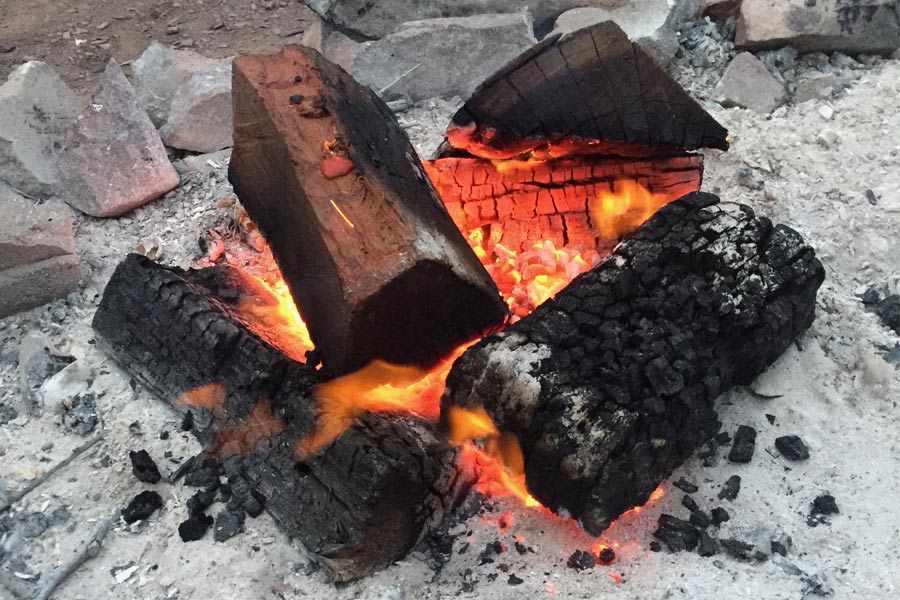
Logs burning into coals on a campfire
The right wood = hot coals ready for some serious campfire cooking. Image: Ben Trewren. 

Looking for Natural Firewood

Whenever you’re looking for firewood in Australia, it’s going to depend ultimately on what is available in your local area. The key is to get your hands on firewood that is not only dry but dense.

Wood available state to state

Across Australia, Jarrah and Wandoo are the species of choice in Western Australia. In Tasmania, Brown Peppermint is considered the best, and in Queensland, Ironbark and Box are the preferred choices. The most popular though is River Red Gum which is the easiest to find in South Australia, Victoria and southern NSW.
Knowing the available species is only a small part of the adventure, as selection also depends on what you are using the wood for, as each species has its own burning rate, flame, coal and ash generation.
For example, River Red Gum is an excellent slow burner, but it doesn’t burn with a lot of flame, so it’s more optimal for cooking. Some species such as Turpentine and White Stringybark don’t produce a lot of flame – so they’re more suited to a wood oven for example.

Test what works for you

Finding firewood that’s perfect for your needs can often be challenging – but never impossible! My recommendation is to try and test locally available firewood to see what works best for you. Alternatively, you could research what species are available in your area of adventure and then use resources such as this one to determine its suitability as firewood.
Also, make sure you do research so you can be certain that you can collect wood in that area – that way you know you’re not disturbing native vegetation or wildlife habitat.
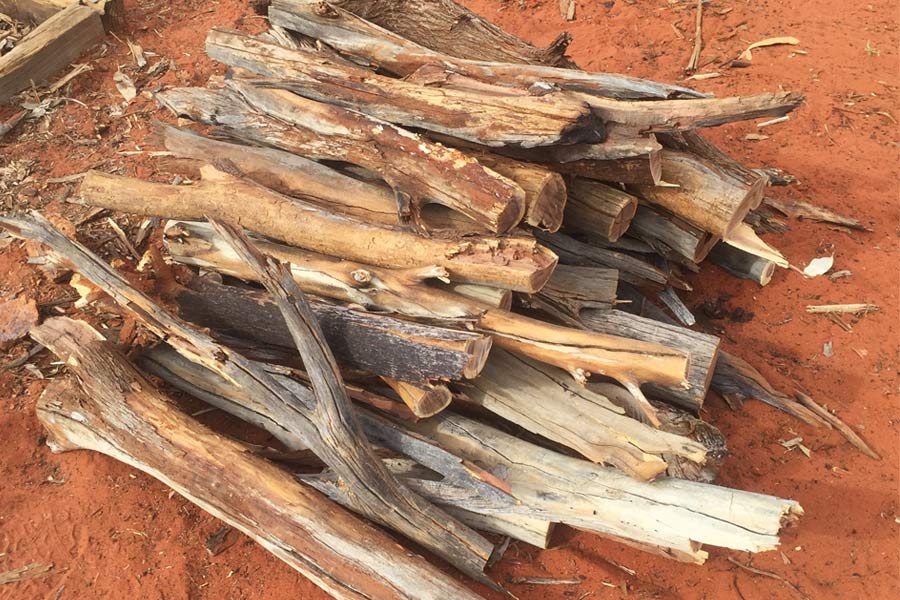
A selction of wood ready for a campfire
A nice selection of wood ready for a campfire. Image: Ben Trewren. 

Purchasing Man-Made Firewood

New to the firewood market is the introduction of man-made firewood called Eco-Logs. Basically, Eco-logs are manufactured from sawdust and shavings that have been mechanically compressed to form a solid log.
By utilising waste material, man-made fire logs help to reduce unnecessary felling of plantation timber and the destruction of habitat for Australian fauna.
There are several benefits of Eco-Logs over natural firewood. Firstly, they can be safely used as a concentrated fuel source, and they contain less than 10% moisture which results in more heat on a weight-for-weight basis.
Man-made firewood is also very dense, which means you burn fewer logs to achieve the same output, and lastly, their compact size makes them easier to store and transport.
The concerns with Eco-Logs compared to natural firewood is that they come with a cost, you need to transport them to and from the supplier, and they don’t develop significantly hot coals.
Ekologs next to a cooker
Man-made firewood is an environmentally friendly and space saving option for campers. Image: Ekologs.

How to Select Firewood

Having decided that natural firewood is what you’re after, here are the best tips I can offer when selecting firewood:
  • Try and pick (or chop) wood to size so logs easily fit within the fireplace.
  • Look for dark to grey coloured wood – this signifies that the wood is older and drier.
  • Get a feel for the weight of the wood. Ideally, the wood should feel light which means little to no water.
  • Knock logs together for a hollow sound and look for wood with cracked ends – this means the wood is dry!
  • Select wood with the bark missing or pulling off. Bark needs moisture to adhere to the wood, this is also a good indication that it’s dry.
Wood chopping logs
Safety first! Make sure you know what you’re doing when cutting up firewood. Image: Ozpig Australia.

Cutting Wood

I just want to mention another safety note when sourcing firewood. If you plan on cutting fallen trees and/or chopping up your own firewood, ensure that you are familiar with how to use a chainsaw, wedge, sledgehammer or whatever else your tool of choice might be.
These tools can become dangerous if not used correctly, and inattention can mean a nasty premature end to what should be a fantastic camping trip.

Can I use Railway Sleepers?

Right across Australia, there are many abandoned railway tracks. Many seeing the sleepers as an opportunity for easy, free and large quantities of firewood. However, it’s important to realise that railway sleepers will likely be contaminated by grease, oil, herbicides and/or heavy metals.
The fumes given off when these products are burned can be toxic. Because of this, I’d recommend avoiding this type of wood for campfires.
So, now that you’ve got the basics for selecting wood down pat, you’re next campfire is sure to be a roaring success!

Sunday, 1 April 2018

Finding or Building a Fire Ring

campfire ring at a designated campground
Campgrounds: Build fires only in designated fire rings, grills or fireplaces. Most developed campgrounds have some version of these. Using a fire ring will lesson your impact and keep your fire contained.
Always check with the campground operator to make sure fires are permitted. In some areas, severe dry periods can cause campfires to be prohibited even in campgrounds.
If you’re car camping in an undeveloped site, check in advance with the agency that administers the land (U.S. Forest Service, Bureau of Land Management, etc.). A campfire permit may be required.
Evaluate the site before starting a fire. If the site is brushy or has low-hanging branches, keep your fire small or skip it altogether. In dry conditions, fly-away embers could easily ignite a wildfire.
Backcountry: In backcountry areas where fires are permitted, use an existing fire ring if one has been left behind. Build a new one only in emergency situations and, if the situation permits, dismantle it when you are done. If one already exists, clean it out before you depart.
Clear away all flammable material from your fire pit. Ideally, the base of your fire should be sand or gravel or mineral soil (often found in streambeds or on gravel bars). Intense heat can sterlize healthy soil, so choose your site conscientiously.
An alternative to a fire ring is a mound fire. Using your sanitation trowel, build a circular, flat platform of mineral soil (sandy, light-colored, nonfertile dirt) about 6-8 inches high. Use this as the base for your fire. Ideally, build this platform on a flat rock. You can easily disperse the mound when you're finished.

Gathering Fire Wood

the various types of campfire fuel: tinder, kindling, and firewood
To burn a successful fire, you’ll need three types fuel: tinder, kindling and firewood.
  • Tinder includes small twigs, dry leaves, needles or forest duff.
  • Kindling consists of small sticks, typically less than one inch around.
  • Firewood is any larger piece of wood and is what will keep your fire going long into the night.
Campgrounds: Use only local firewood. Nearby stores often carry firewood, and sometimes campground hosts offer bundles of firewood or kindling for sale.
Do not bring wood with you if you’re traveling from more than 50 miles away. Campgrounds may even ban bring-your-own firewood regardless of the distance you travel. Why? To avoid introducing troublesome insects into a forest.
Call the campground or a local ranger office in advance for information and advice.
Backcountry: If you forage for firewood, gather only downed wood far from your site. Never cut live trees or break off branches from standing trees, even dead trees. Birds and wildlife make use of dead branches and snags.
Do not gather or burn pieces thicker than an adult's wrist. This is because thick chunks of wood are rarely allowed to burn completely and are typically left behind as blackened, unsightly scraps.
Remember to follow Leave No Trace principles when gathering wood. 

Building a Campfire

three different types of campfires to try: teepee, log cabin, and pyramid
Kindling and firewood can be assembled in a number of different ways. Popular styles include the teepee, log cabin and upside-down (or pyramid).
Teepee: Start with a small cone of kindling around a few handfuls of tinder that are loosely piled in the center of the fire ring. Once the fire is going strong and the temperature increases, you can add larger logs a few at a time as needed.
Log cabin: Place two larger pieces of firewood parrallel to each other and with some room in between to form the base of your structure. Then, turn 90 degrees and place two slightly smaller pieces on top and perpendicular to form a square. Place plenty of tinder inside the square. Continue adding a few more layers of firewood around the perimeter, getting a little bit smaller with each layer. Finish with a layer of kindling and tinder across the top. Remember to leave space between logs so the fire can get plenty of oxygen.
Upside down (pyramid): Start with three or four of your largest logs side-by-side on the bottom layer. Turn 90 degrees and then add a second layer of slightly smaller logs on top. Continue alternating a few more layers in this manner, getting smaller as you go. Place your kindling and tinder on top.

Lighting a Campfire

a camper lighting a campfire
Light the tinder with a match or lighter. Using fire starter that is designed to easily ignite can help the tinder catch the flame. (Be sure to carry waterproof matches and firestarter. Fire-making materials are considered one of the Ten Essentials.)
After lighting the tinder, blow lightly at the base of the fire to provide oxygen, which will help increase the intensity of the flame and further ignite the wood.
As the fire burns, move embers to the center to burn them completely. Ideally, you should reduce them to white ash.
Shop REI’s selection of fire-starting gear.

Extinguishing Your Campfire

using water to extinguish a campfire
Extinguish all fires by pouring water on them, stirring the ashes, then applying more water. Repeat as often as needed. Ashes should be cool to the touch before you leave the site. Be utterly certain a fire and its embers are out and cold before you depart.
Never leave a campfire unattended!

Cleaning up Your Campfire

Burn trash items only if they can be fully consumed by fire and turned to ash. Do not attempt to burn plastic, cans or foil. If you do burn something that's not fully consumed, collect the remains when the fire is out and either pack it out or put it in a trash receptacle.
When you’re in the backcountry, pack out any trash found in your pit. Extract any charcoal pieces left inside your ring, carry them away from your site, crush the chunks, then scatter the remnants and dust throughout a broad area. Dismantle any structure you might have built.

Wild Camping Tips and Kit List

The first rule of Wild Camping club is...  actually really simple! Leave No Trace: if you take it in, you carry it out. What is wild camp...