
Showing posts with label wild edibles. Show all posts
Showing posts with label wild edibles. Show all posts
Monday, 13 August 2018

Friday, 8 June 2018
Wilderness Survival food
Wilderness Survival food
It is essential to understand where to find survival food, even food is the least pressing wilderness survival need. With plenty of water and a comfortable resting place, most of us can live many weeks without food.
However, food is important for your mental and emotional state, as well as a source of energy and to maintain a normal body temperature.
Natural food
However, food is important for your mental and emotional state, as well as a source of energy and to maintain a normal body temperature.
Natural food

Meat and fish are good sources of protein and fat and provide virtually everything a long-term survivor would need. However, at the first stage of a survival situation, plants are the most appropriate diet as plants are easily accessible and contain the necessary carbohydrates.
Wild edible plants
Depending of the time of the year you will almost always find edible plants, unless you are in the middle of an arid desert. Knowledge of only one or two wild edible plants can be of great help in your search for survival food. Learn more about eating wild plants.
Edible insects
Your most vital nutritional needs in a survival situation are protein and fat. Most insects are rich in both. Turn off your cultural bias against eating insects. Edible bugs are good "survival food".
Fishing
Fish are a valuable food source. Therefore, if you are near a river or stream, fishing is an important alternative to obtain food. Learn different simple methods of catching fish.
Trapping
Unless you are an experienced hunter, hunting animals for meat is inadvisable in a survival situation. Hunting is difficult and you will expend a lot of energy to get your food. Instead of hunting consider trapping. Trapping requires less skill and leaves you free to spend time searching for other food sources. The wilderness survivor needs simple traps that are easy to remember and easy to construct.
Bird eggs
Eggs offer high nutritional value, are convenient and safe. They can be boiled, baked or fried. The first obvious place to look for them is a bird nest. However, not all birds build a nest, but instead lay their eggs directly on the ground or in a hole.
Reminder: Collecting wild bird eggs are not allowed in most countries. Eating wild bird eggs should only be considered in a wilderness survival situation.
Methods of cooking
Cooking is a skill of great importance for all wilderness travelers. Cooking not only makes many foods more appetizing to taste, but also ensure that parasites and bacteria are killed. You don’t want to get sick from food poisoning.
A compact camping stove is very convenient in the wilderness. However, in many situations, a cooking fire is more practical and allows a wider variety of cooking opportunities. As a survival skill, you should also be able to prepare your food without any cooking utensils.
Source: https://www.wilderness-survival-skills.com/survivalfood.html
Wednesday, 9 May 2018
Wild Garlic Recipes
Wild Garlic Recipes by catherine
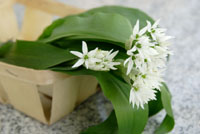
Anyone who’s walked through a wood and smelt that distinctive onion-y smell has been near one of the commonest, but little used, wild foods. Wild Garlic (Alium ursinum) or ransoms is common in woods all over the UK. There are usually plenty of them – they spread rapidly once they’re established.
Ransoms have glossy flopped-over, rabbit-ear shaped leaves and white, star-shaped flowers. They’re easy to identify, because you’ll be able to smell them. Fortunately, they don’t taste nearly as strong as they smell!
Unlike cultivated garlic, the bulbs are very small and not worth bothering with. Just cut some leaves at the base without disturbing the plant. The leaves can be eaten raw or cooked.
I think the best uses for them are the simplest: an omelette made with your freshest eggs with some garlic leaves snipped into them.
For something more substantial:
Wild Garlic and Potato Soup
25g butter
couple of handfuls of wild garlic leaves
2 medium-sized potatoes
800 ml of chicken or vegetable stock
salt & pepper
Melt the butter in your soup pot. Roll the leaves, cigar-fashion, and then slice across into strips. Add them to the pot and put the lid on. Let them soften in the butter while you peel and chop the potatoes into cubes. When the leaves are wilted add the potatoes and the stock. Bring up to the boil, then simmer for 20 minutes or until the potatoes are really soft. If you like, add a spoonful of cream and liquidize the soup.
They’re also good in Chinese-style stir frys with some ginger and a splash of soy sauce.
Ransoms have the same health benefits as cultivated garlic, in fact they are thought to be superior. Tucking in might also keep away those troublesome midges (see blog http://www.woodlands.co.uk/blog/wildlife/midges-mosquitoes-and-marmite-coping-with-insects-in-woodlands/) !
Does anyone know if you can use the flowers and seeds like you can with chives?
Subscribe to:
Posts (Atom)
Wild Camping Tips and Kit List
The first rule of Wild Camping club is... actually really simple! Leave No Trace: if you take it in, you carry it out. What is wild camp...

-
The first rule of Wild Camping club is... actually really simple! Leave No Trace: if you take it in, you carry it out. What is wild camp...
-
How to Start a Campfire: Ultimate Guide Me make fire. Fire good. Fire bring warmth and cook food. Our relationship with fire spans back...


